
Taiwan’s east coast is a wild place. Steep jungle-clad mountainsides plunge into the frothy Pacific Ocean. Unlike crowded and industrial western Taiwan, the east coast is sparsely populated. Taiwan’s Highway 11 winds around the coastal cliffs, connecting a series of aboriginal villages. This road has a dedicated bike/motorbike lane for much of its length, making it a good destination for road cycling. We cycled from the city of Taitung in the south to the city of Hualien in the north.
The majority of the world’s bicycles are manufactured in Taiwan, and as a result there is an active cycling culture in Taiwan. We got a hint of this in Taipei’s international airport, where this sign greeted us.
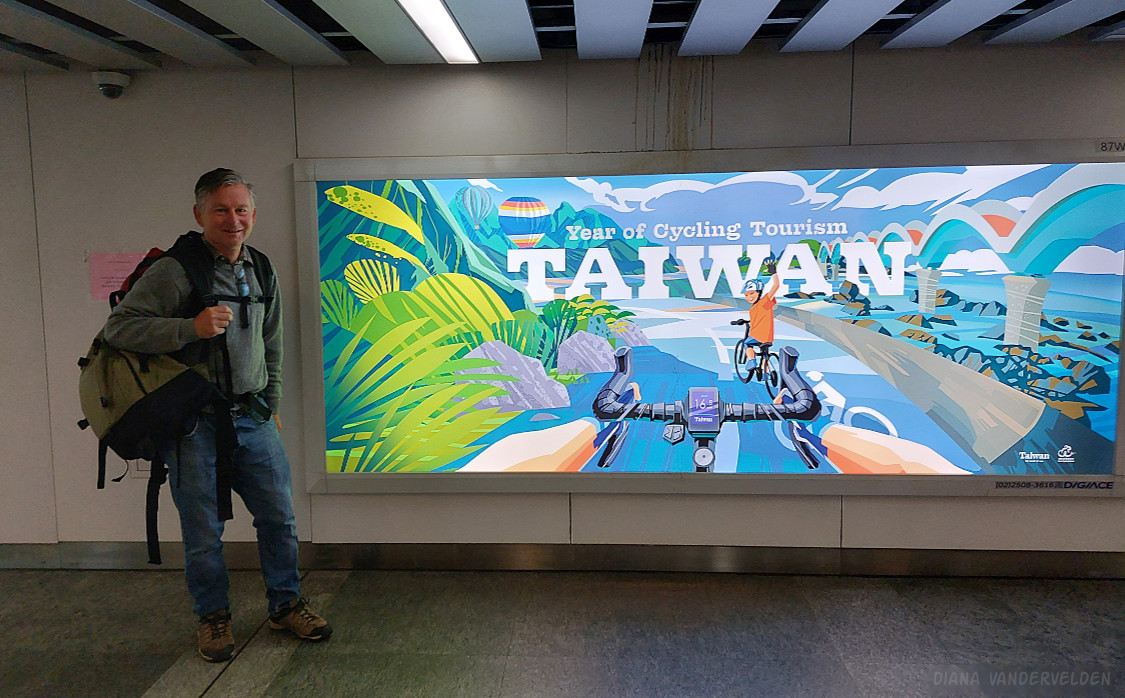
From Taipei we took a train to Taitung, a five-hour journey.
Day 1
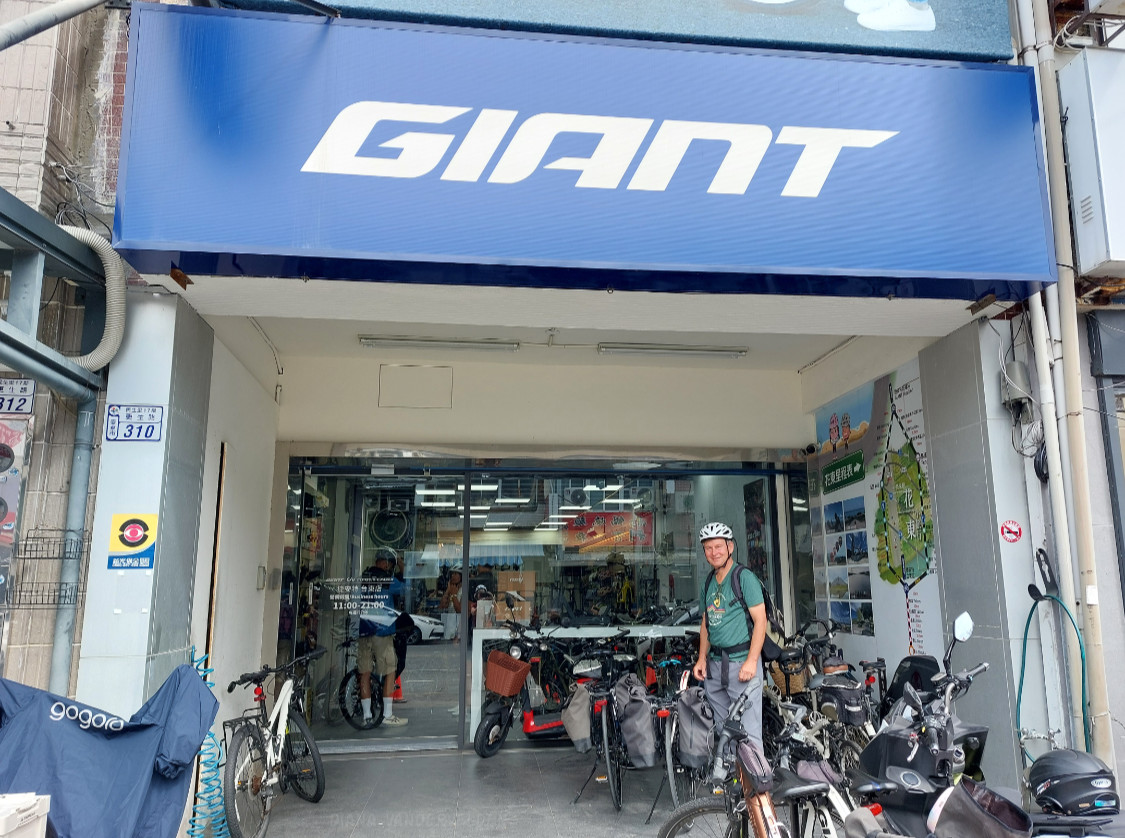
The next morning we picked up our bikes at the Giant bicycle store.
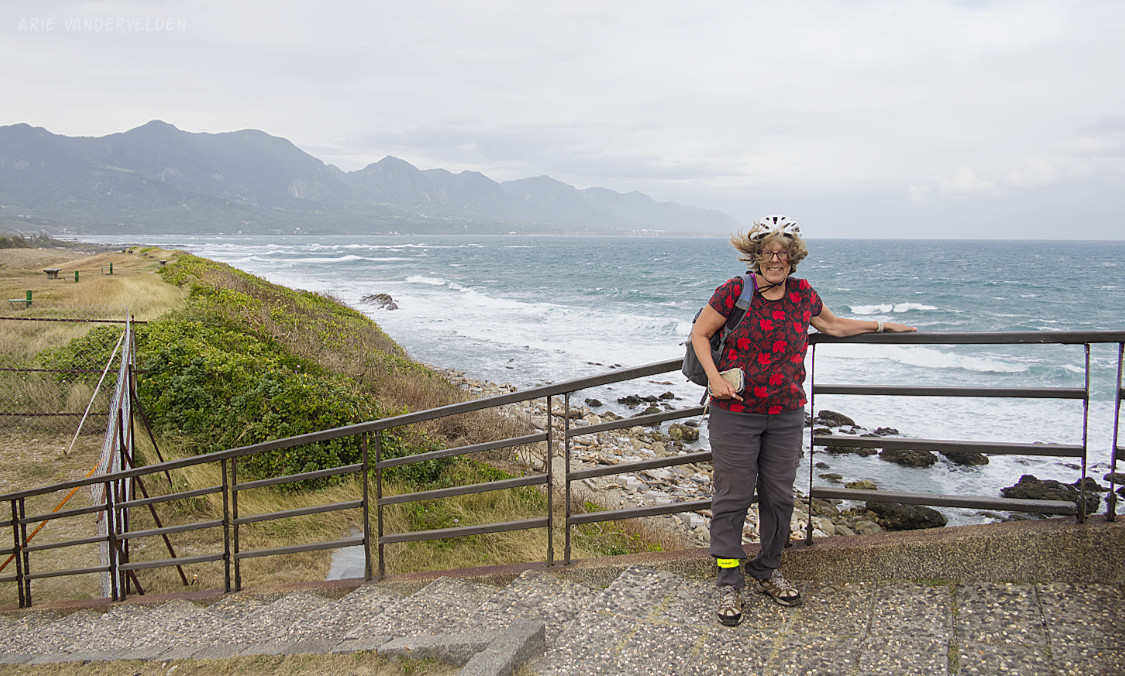
The center of Taitung is a kilometer or two from the seafront and Route 11. We rode out to the seafront park and stopped for a picture.
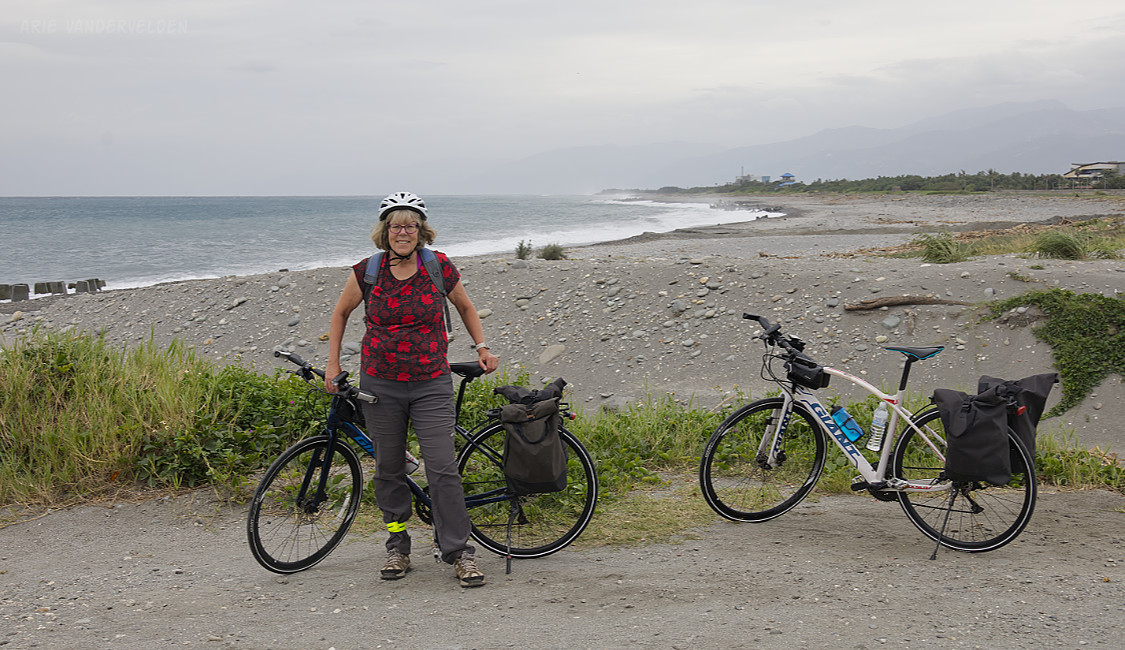
It was cloudy and windy, and furious waves pounded the shoreline. Keen to get going, we headed north on Route 11 across a huge outwash plain. We rode past the noisy airport where fighter jets were stopping to refuel. It was a stark reminder of Taiwan’s political situation.
Just past the airport was a geopark – a park dedicated to geology. This was right up my alley! We parked our bikes and had a look around on foot. The main attraction was a series of sandstone beds that were deposited in a deepwater setting. Deepwater sediments are usually fine-grained, reflecting the quiescent conditions on the deep ocean floor. These coarse sands are thought to have been swept into the abyss by turbidity currents. After lithification, the sandstones were then uplifted to where we can see them today. Sandstones of this type are attractive targets for oil and gas exploration, and here is an opportunity to study them at the Earth’s surface. Fascinating stuff.
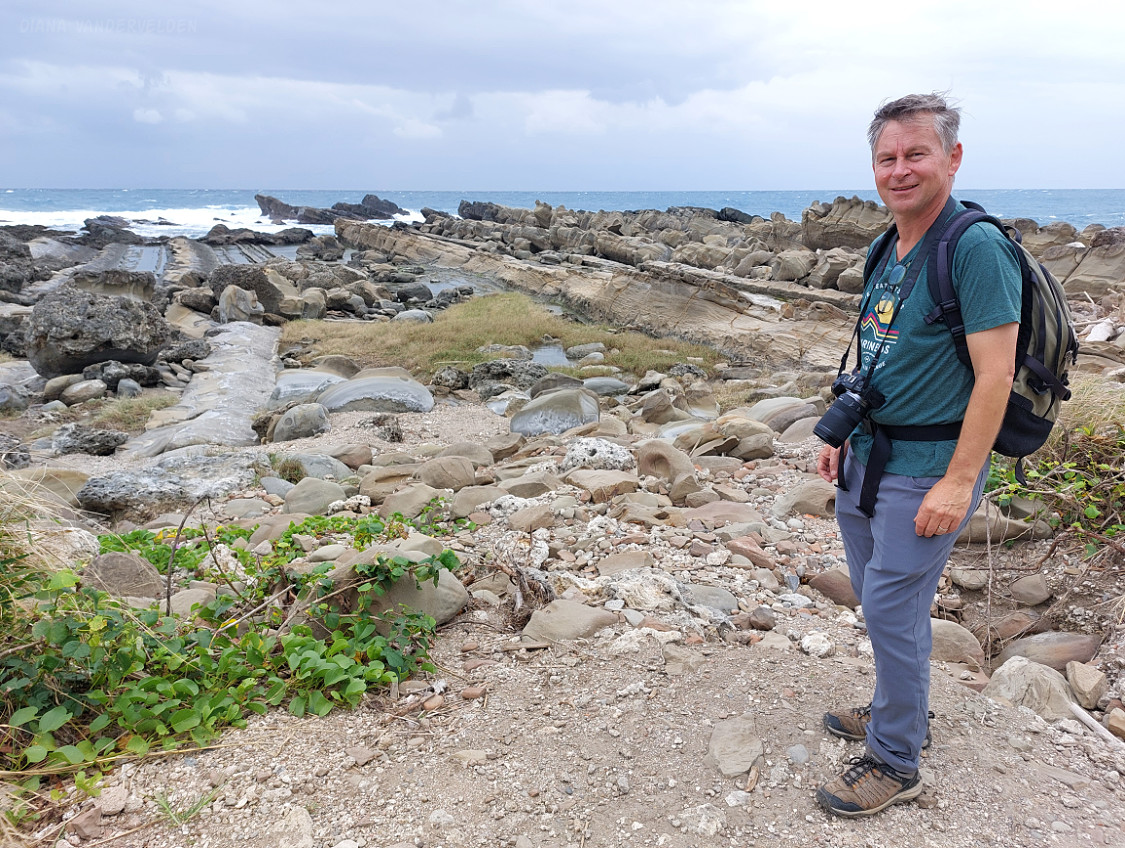
We pulled out at a viewpoint overlooking the sea. It was very windy. It took a lot of effort making northward progress on our bikes with a headwind this strong.
We found a nice place for lunch at Shanyuan Beach.
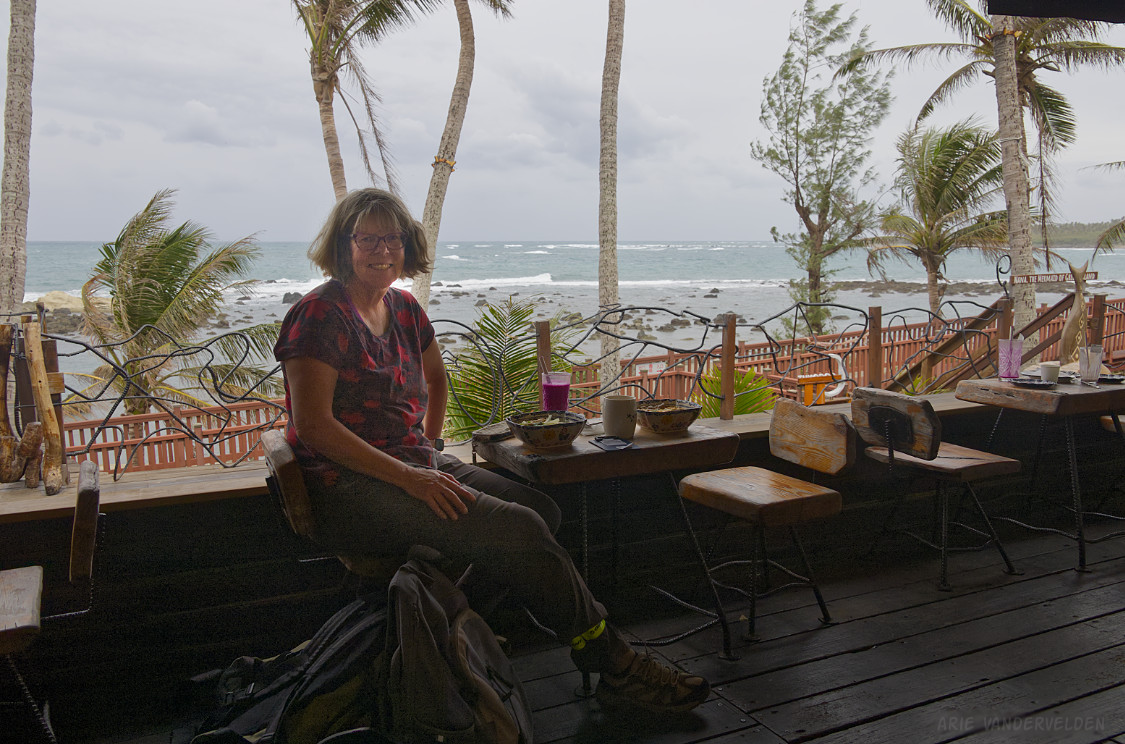
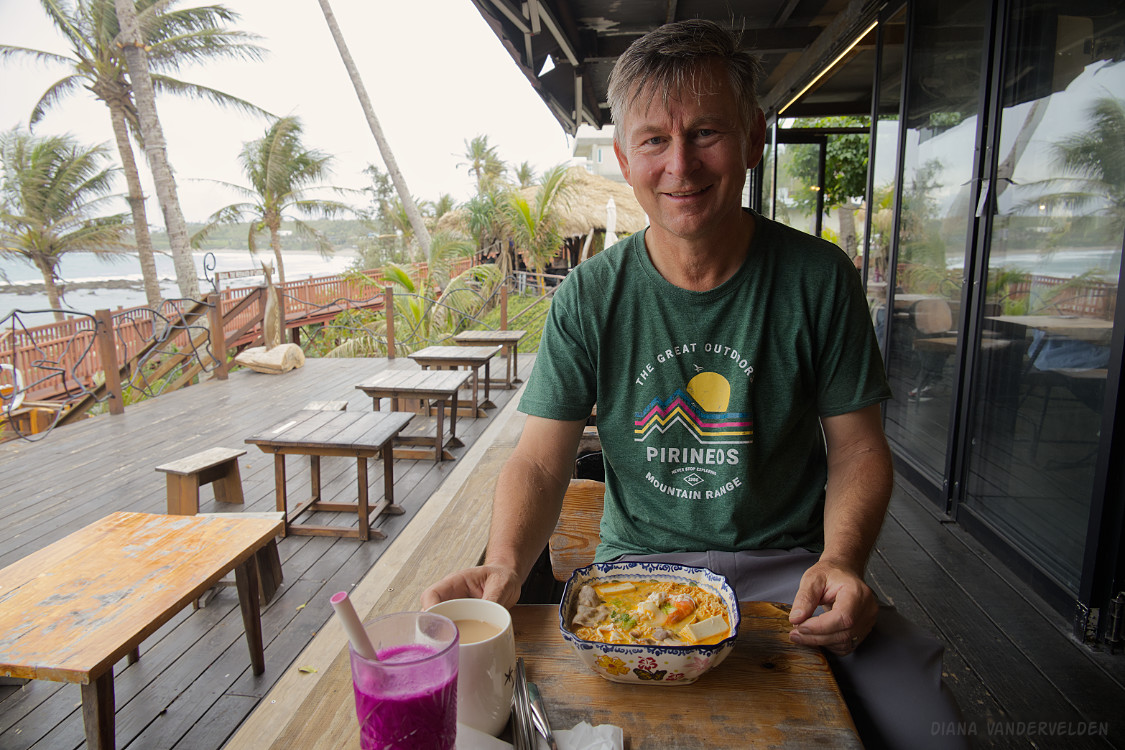
We ordered some noodle soups. I had mine with a Taiwanese milk tea, and Diana had a purple dragonfruit smoothie.
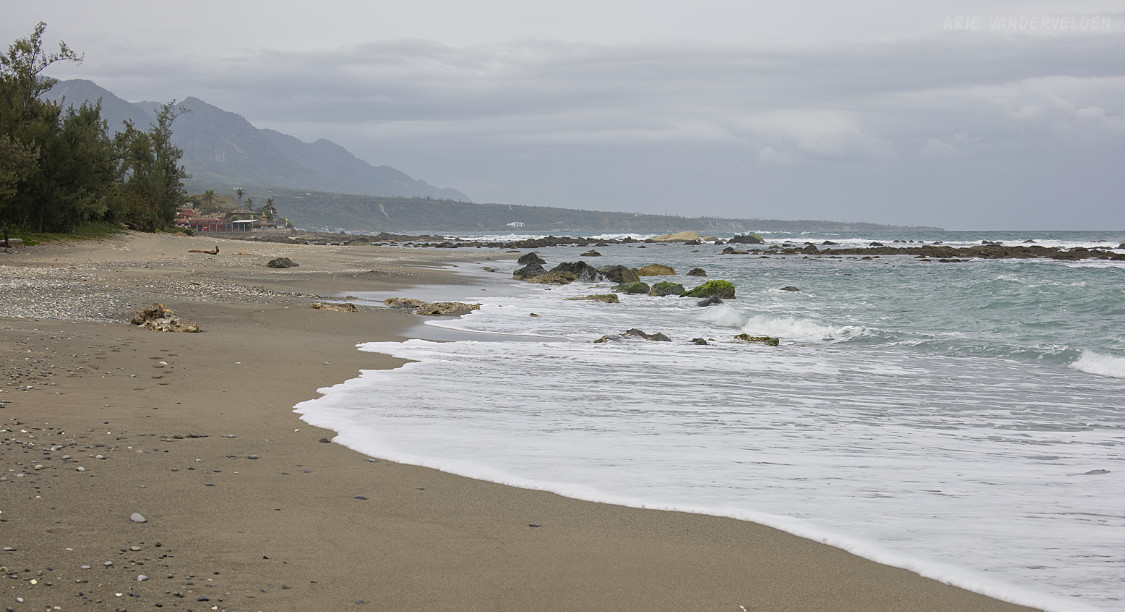
On a sunny day, the ocean at Shanyuan Beach is supposed to have beautiful deep blue water. But today, the water was grey.
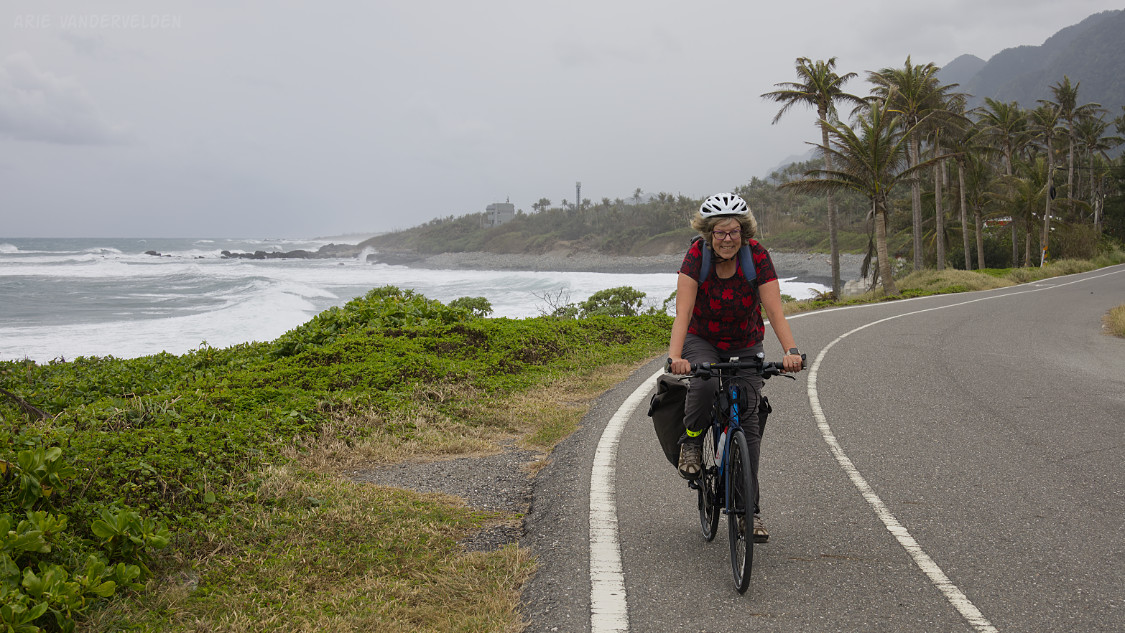
After lunch we continued cycling northward on Highway 11. Note the bike/motorbike lanes at the side of the road.
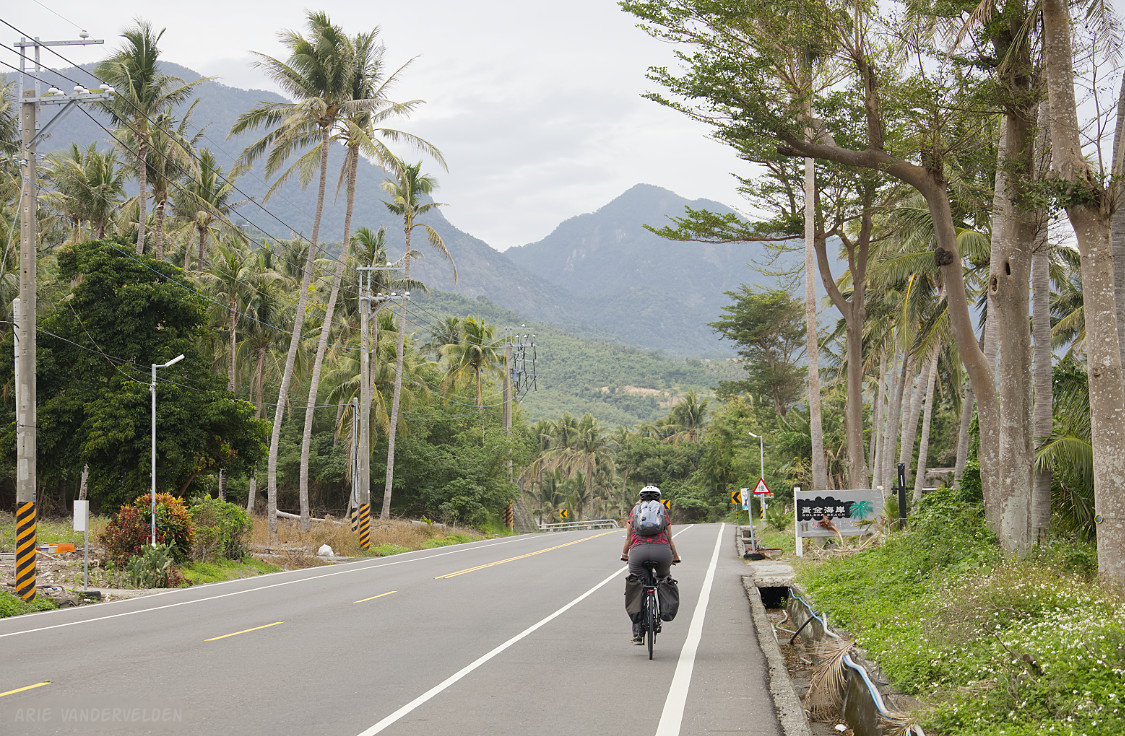
Viewpoint.
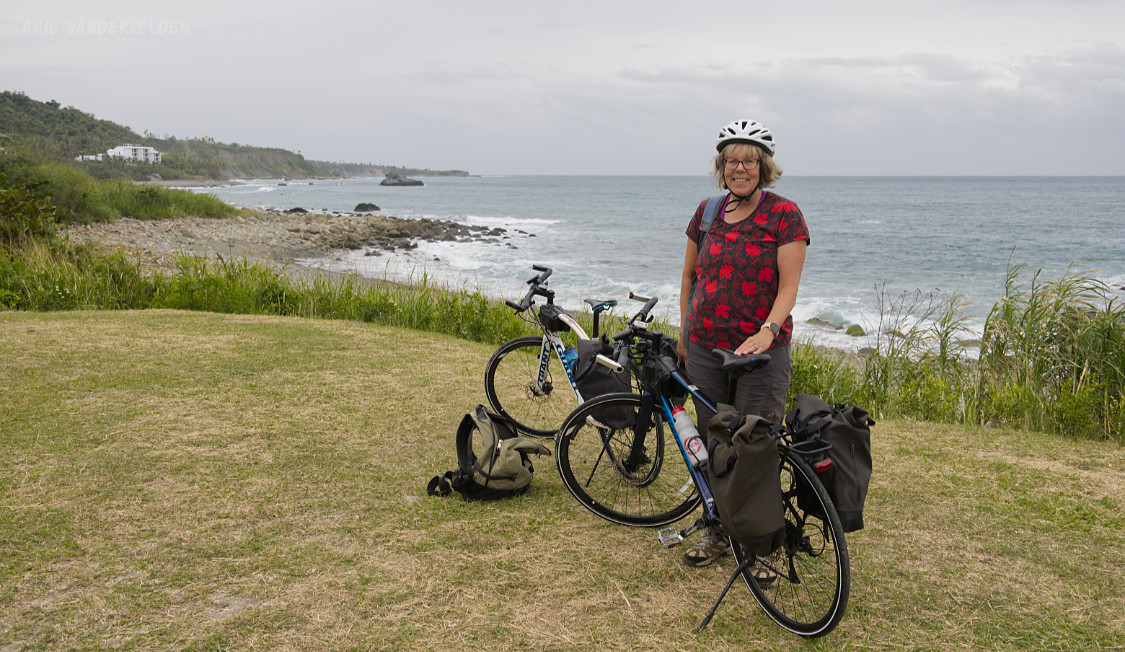
Macaque monkey on a guardrail.
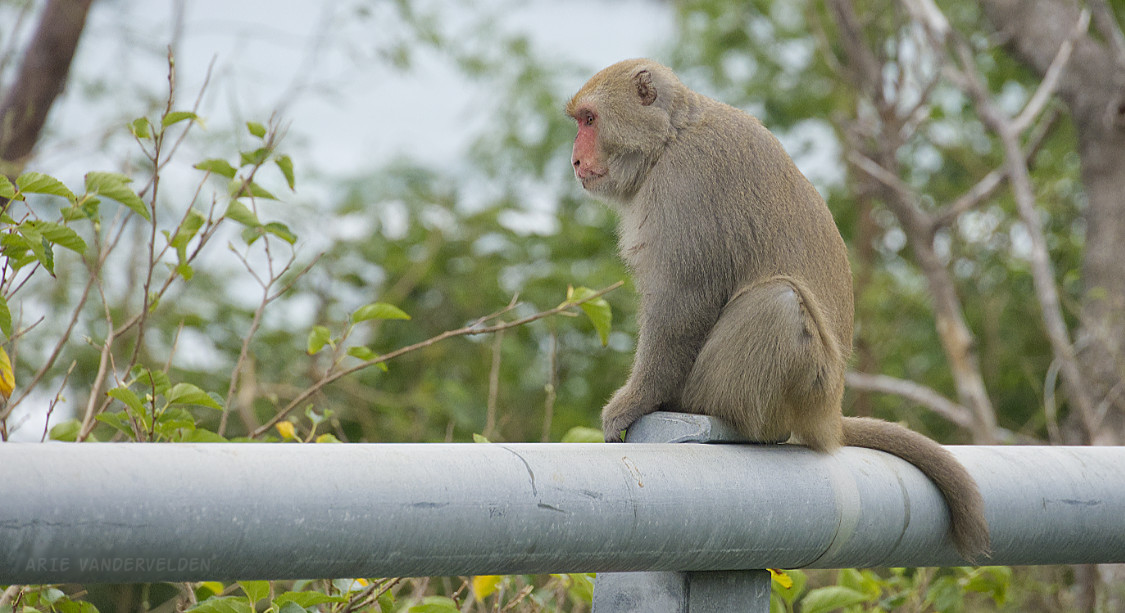
Another viewpoint.
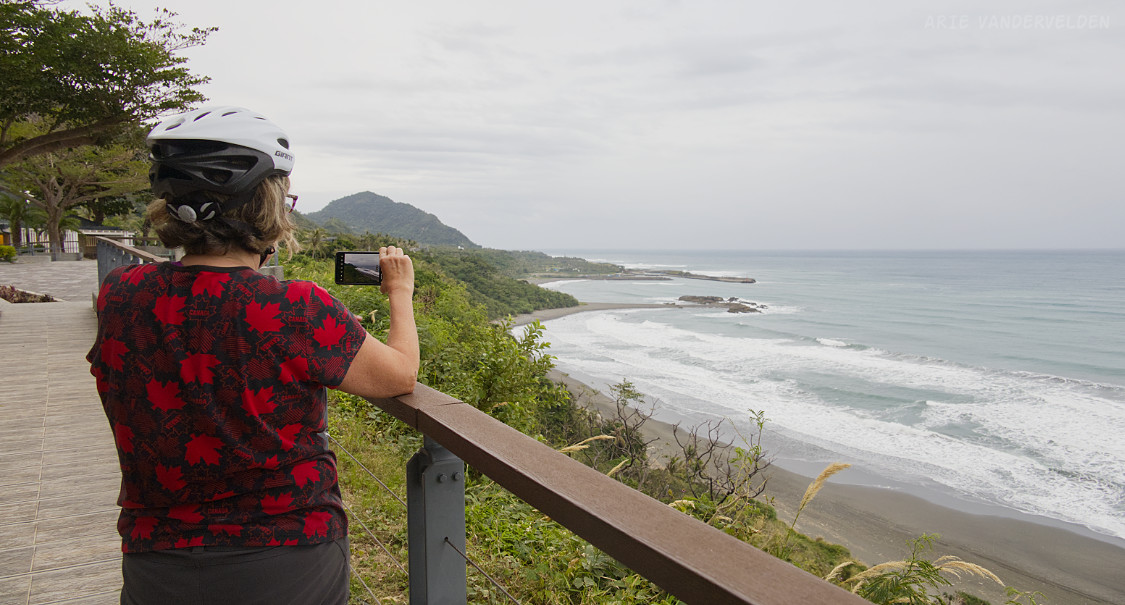
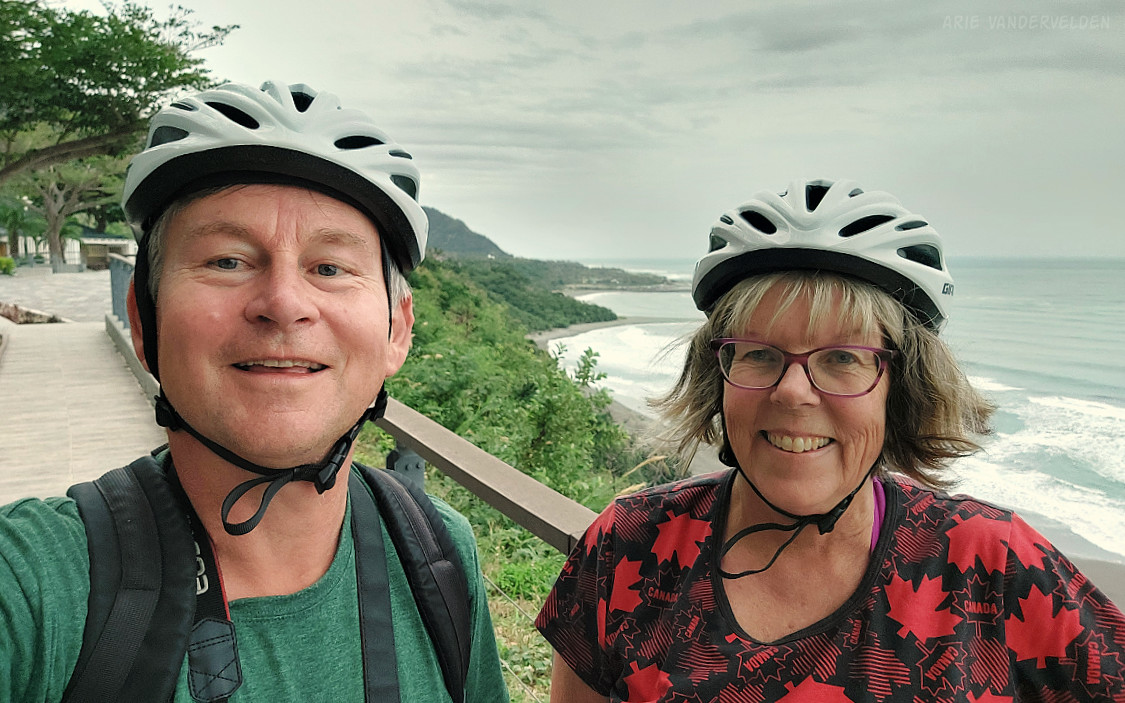
Cellphone selfie – happy to be cycling.
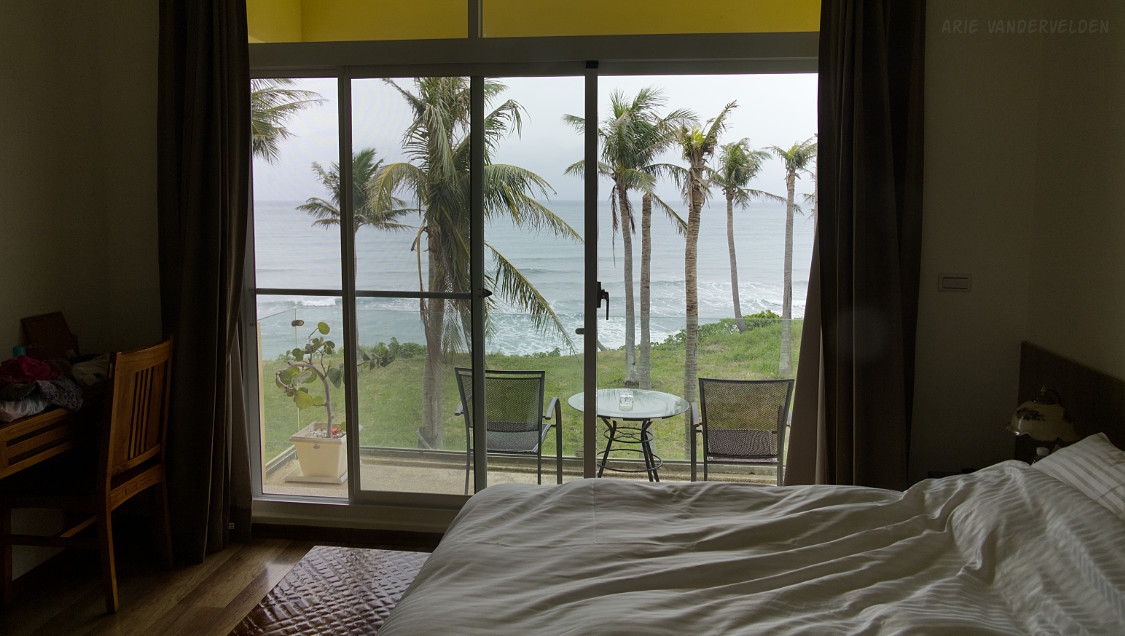
We ended our day of cycling at the village of Donghe. The balcony of our B&B had a really nice ocean view, which we didn’t want to leave by going out for dinner. So instead I picked up some supplies from the convenience store down the road. Later that evening we were lulled to sleep by the sound of the surf crashing against the cliffs.
Day 2
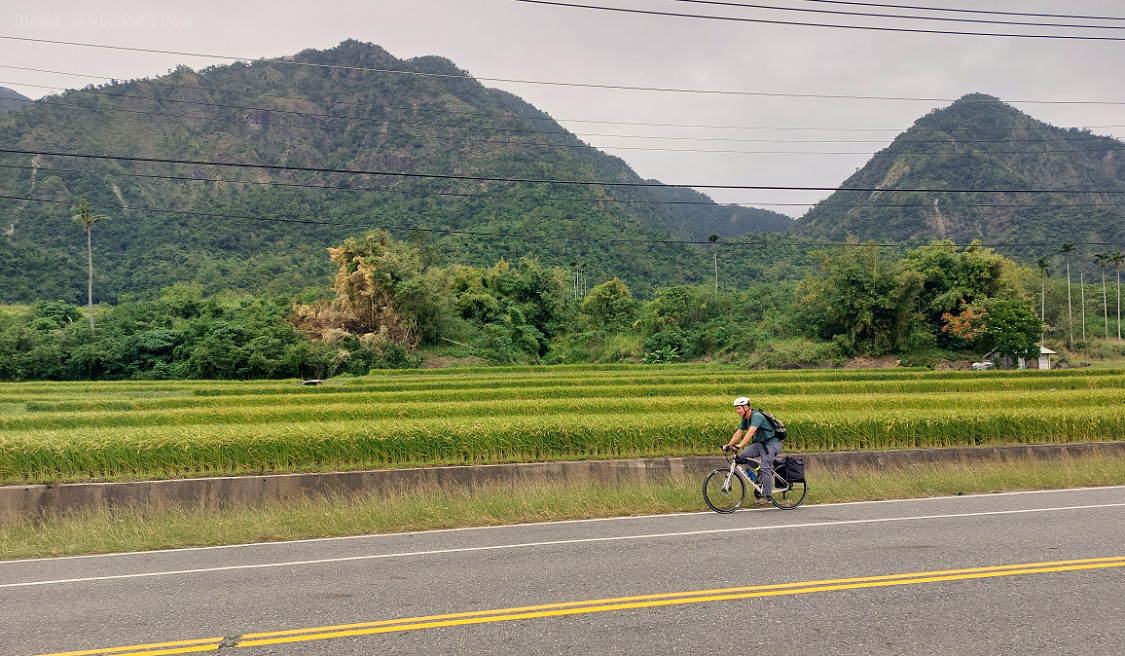
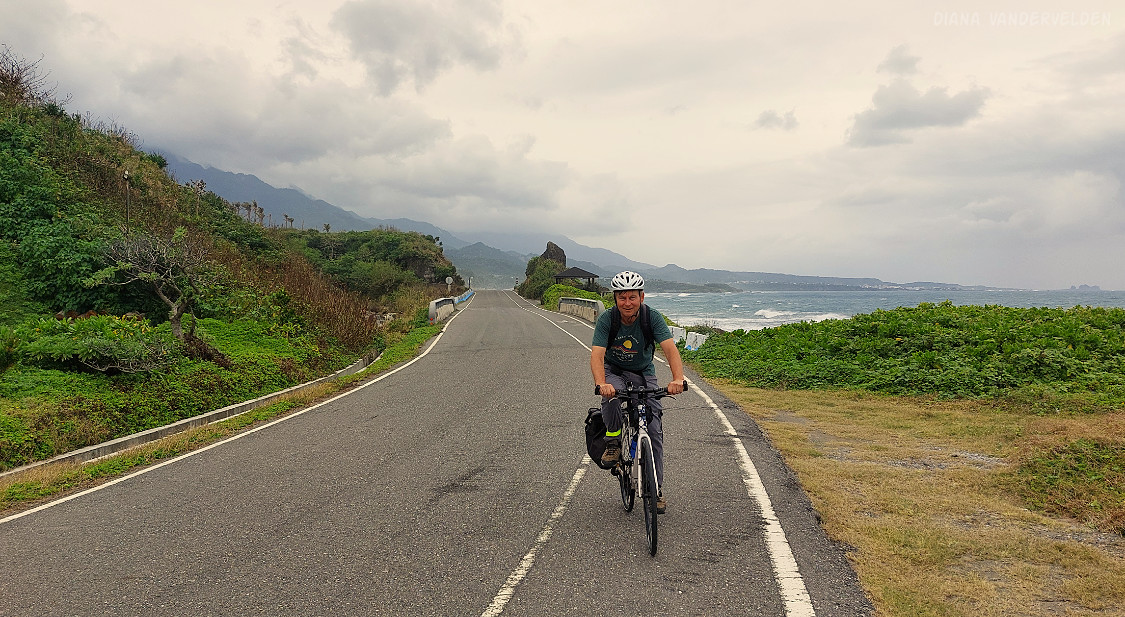
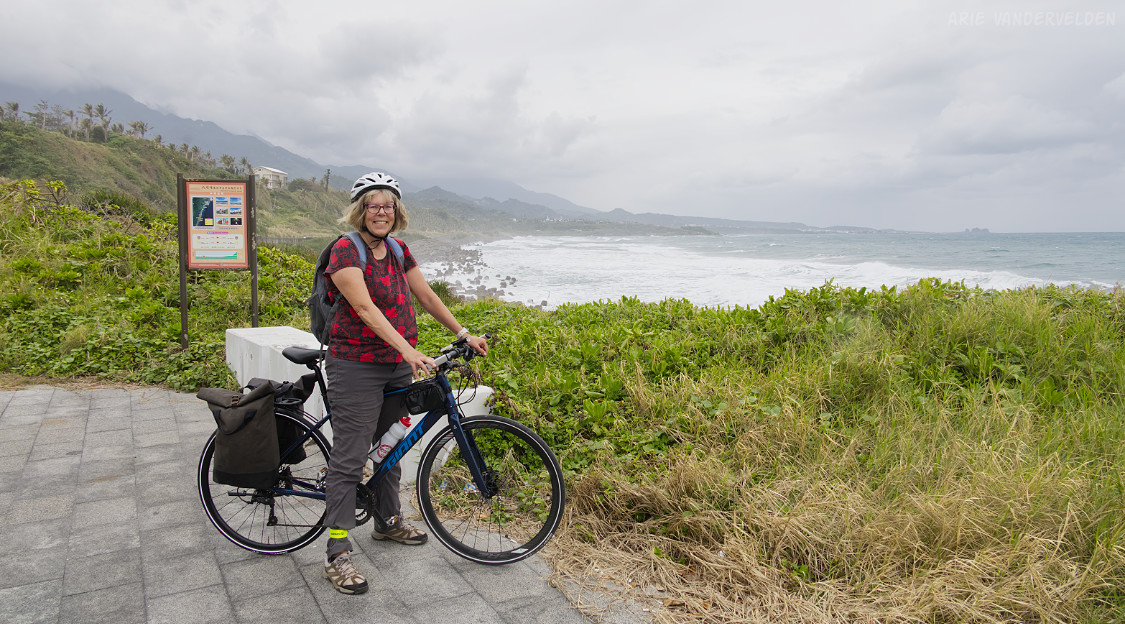
Day two began cloudy and windy. However the cycling was quite enjoyable.
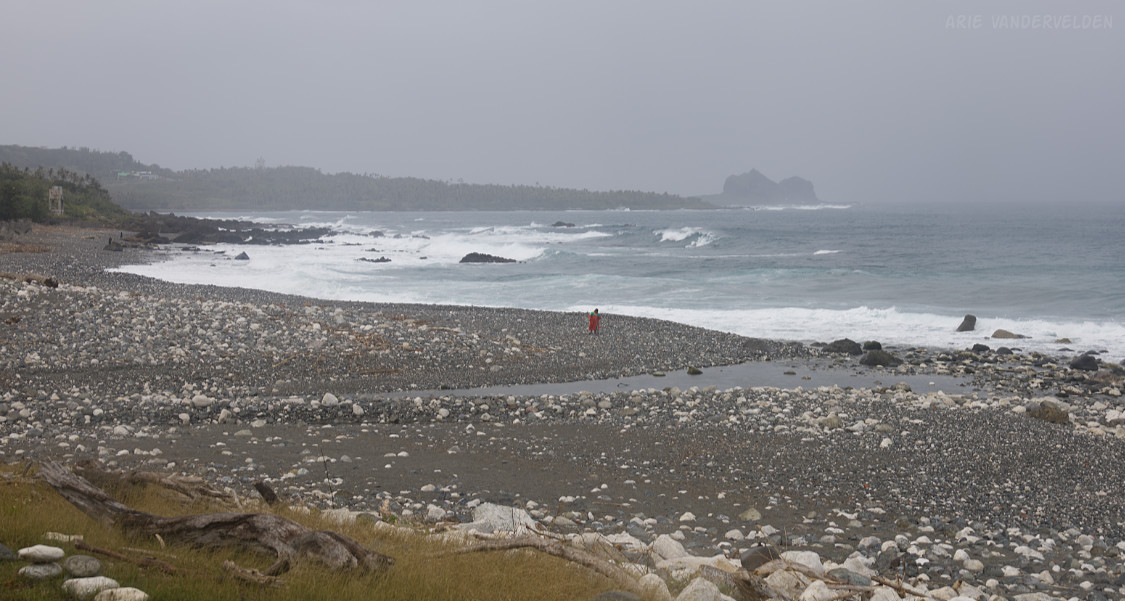
By mid-morning it started to rain. At the larger town of Chenggong we stopped at an oceanside park, and we huddled in a gazebo waiting for the rain to pass. The shelter had a nice view of the beach.
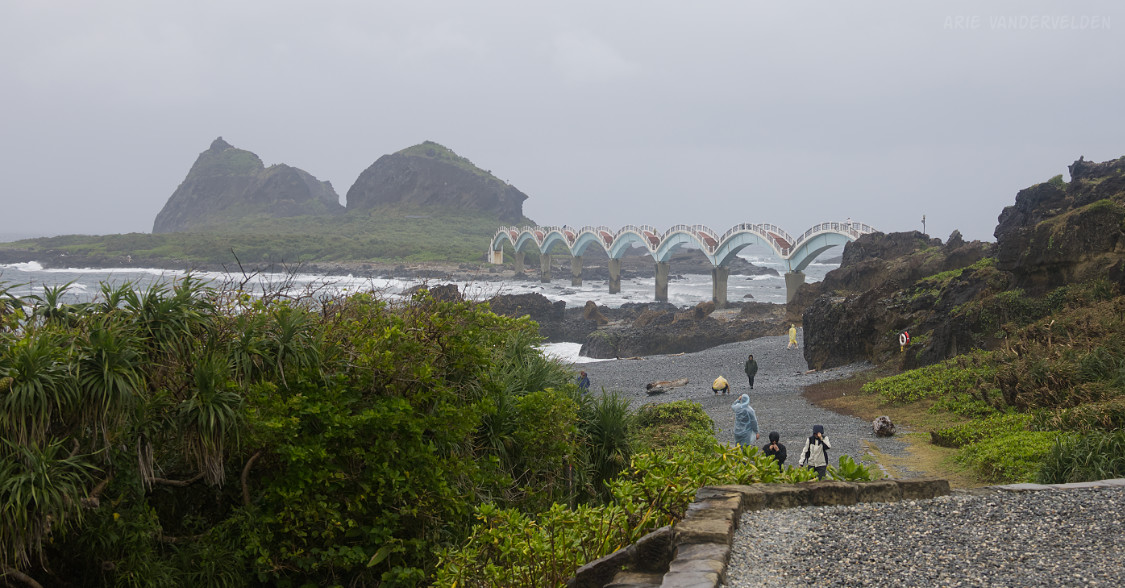
The rain did not stop, so we ventured on. Our next stop was Sanxiantai Bridge, a pedestrian bridge with eight arches, evoking the shape of a dragon. This bridge is a major tourist attraction and there were some bus tourists milling about. However the weather was foul and we skipped walking across the bridge.
The rest of the day was miserable, with rain pouring down. Thankfully the wind died down a bit allowing us to make forward progress. We passed many dramatic viewpoints that would have been nice stops on a sunny day, but we pressed on. Passing vehicles sent up clouds of spray, and we arrived at our B&B soaked to the bone. After changing into dry clothes the B&B owner kindly drove us to a nearly restaurant. The restaurant served pizza and pasta. European-style accordion music was blaring from a stereo system, making conversation utterly impossible. It was a surreal experience, but we were thankful for the ride and a hot meal. Back at the B&B I spent the rest of the evening drying our shoes with a hair dryer.
Day 3
On the third day the rain had stopped, and we were back to clouds and wind. After cycling a short distance we pulled out to look at the furious sea.
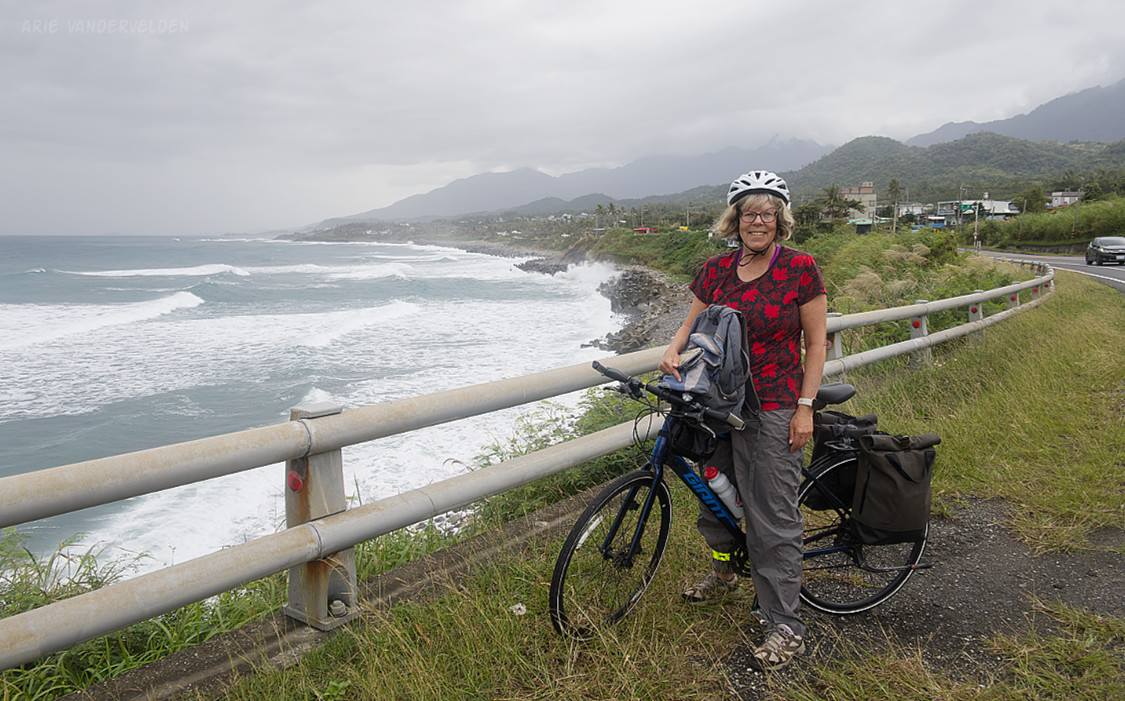
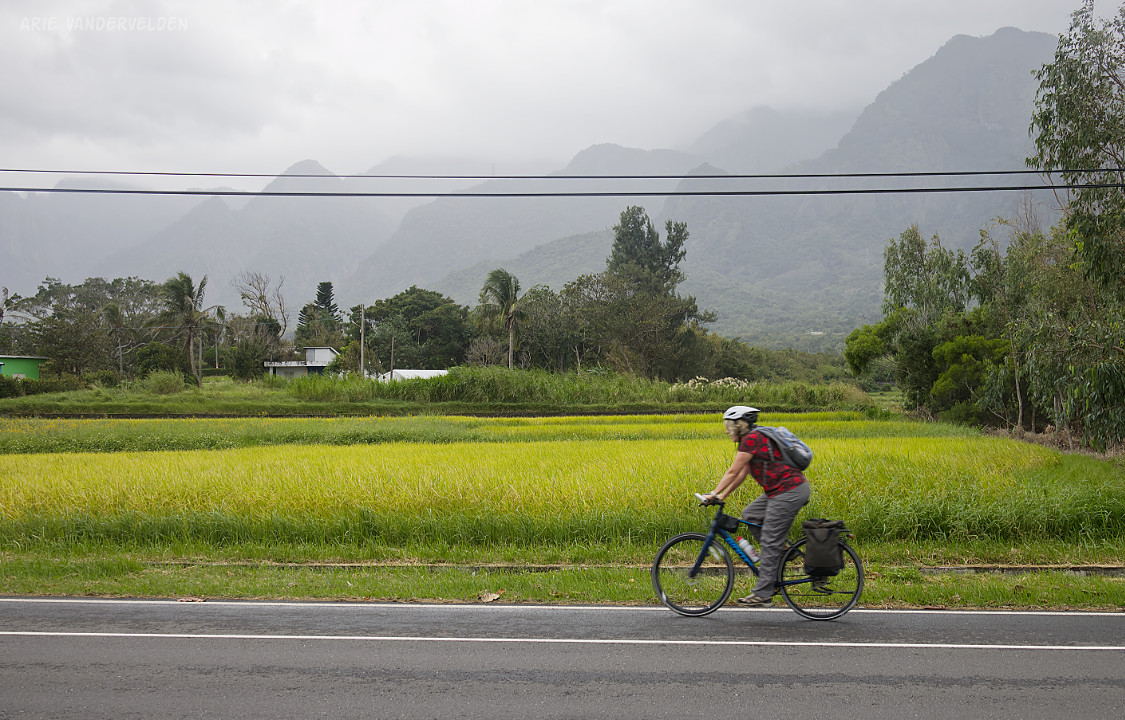
On our right, huge surf pounded the cliffs below us, while on our left were green mountains and green rice paddies.
We stopped at a beach. In any other tropical country this beach would have extensive development along it. But here there was nothing – only the ocean, beach, and sky.
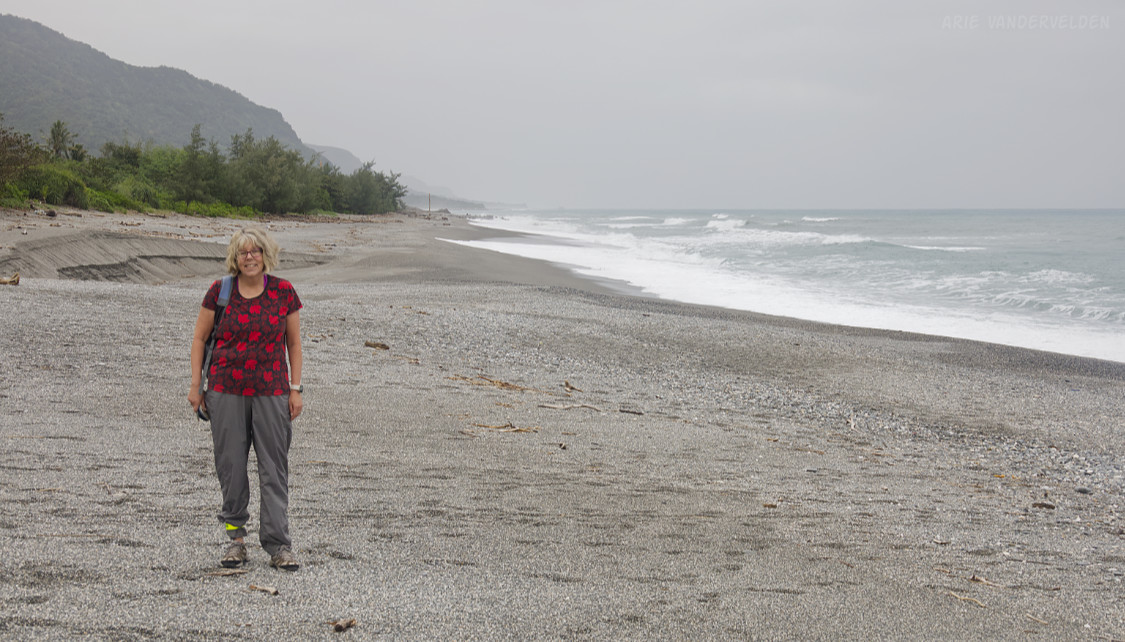
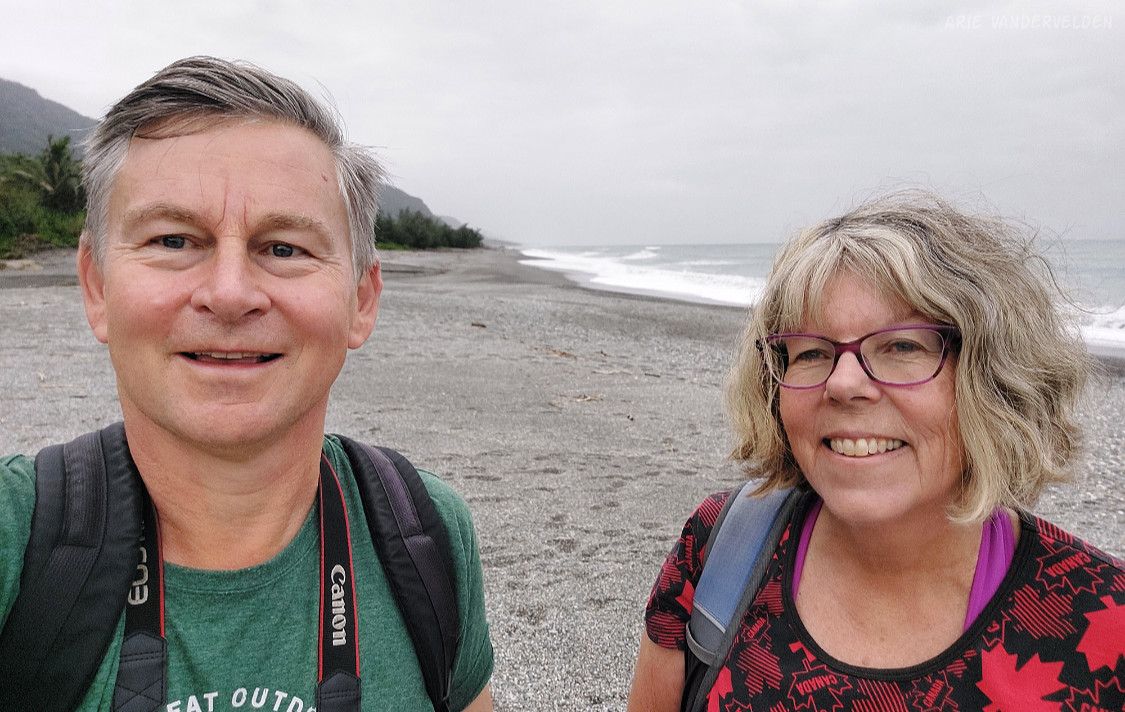
Selfie.
Our next stop was at Baxiandong caves. Here, a series of sea caves have been uplifted above sea level – the highest caves being the oldest. Human artifacts found here date up to 30,000 years ago. This is very, very old. This archeological evidence lends support to a theory that Taiwanese aboriginal people spread from Taiwan to the Philippines to Indonesia, and from there to Australia and the South Pacific. Interesting stuff.
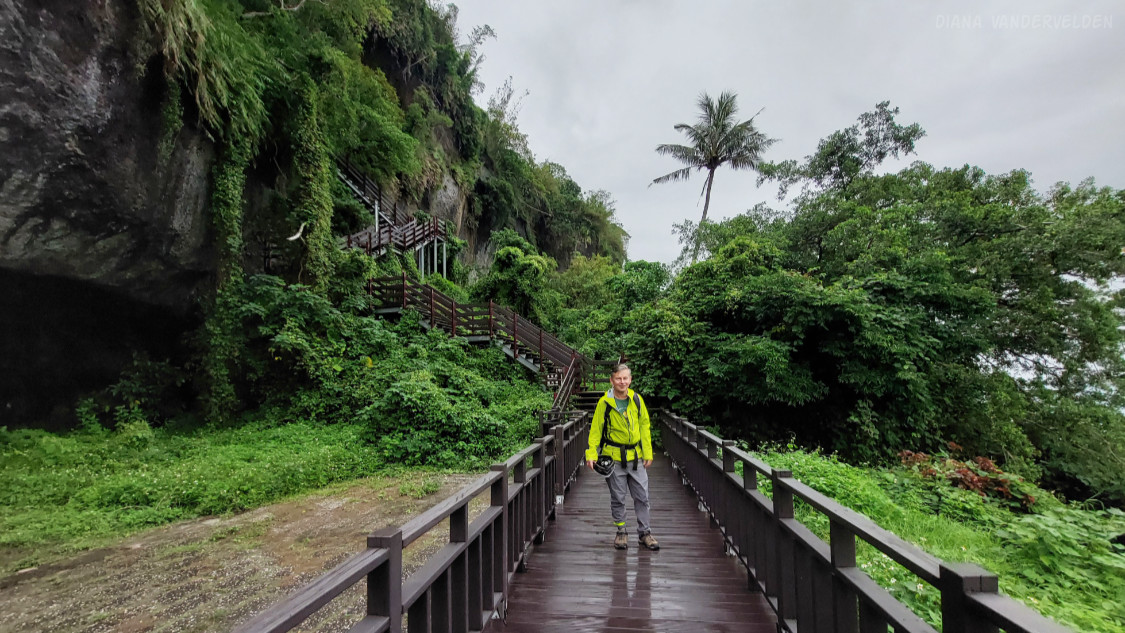
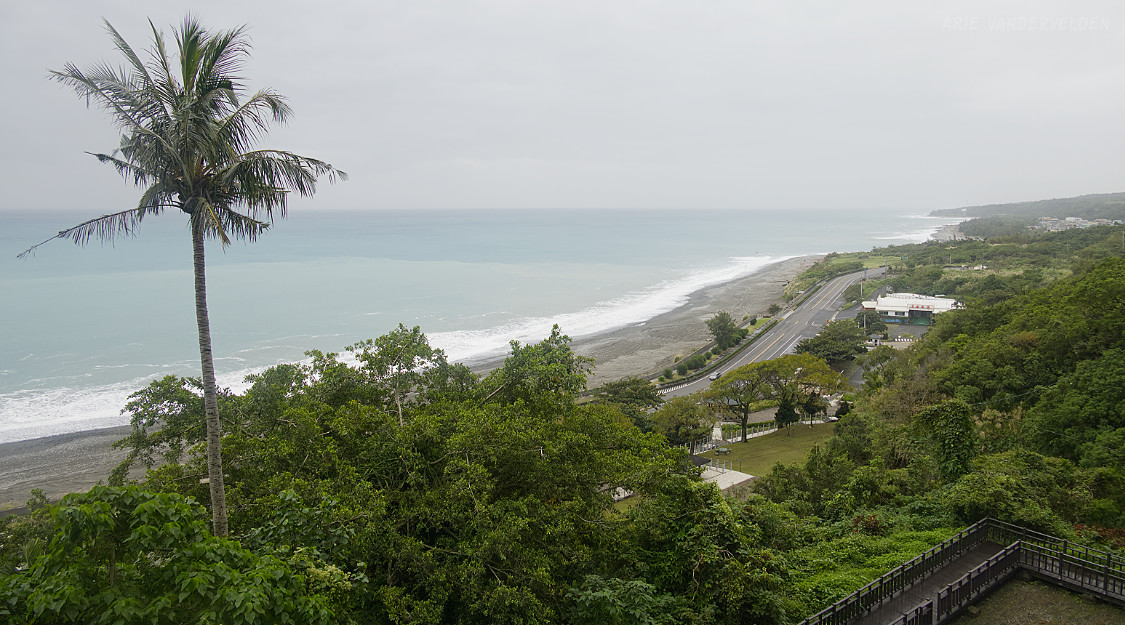
I climbed the staircases to try to reach some of the higher caves, but after some distance the trail was blocked due to damage from the recent rains. Still, this provided a nice view of the coast. I can only imagine the colour of the sea on a sunny day.
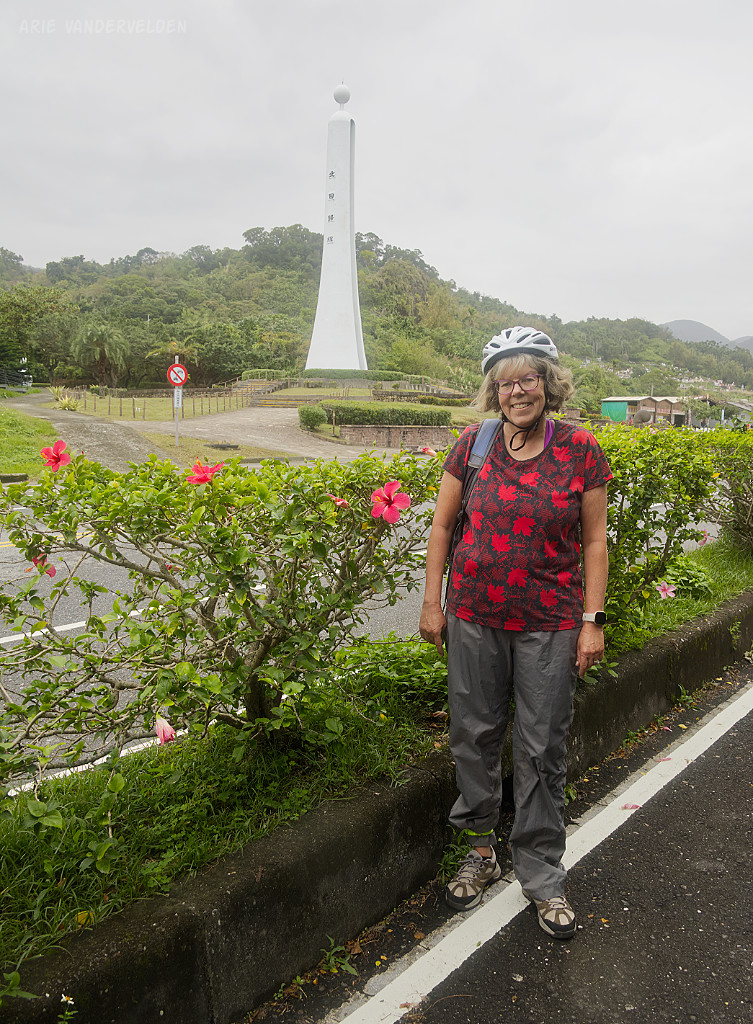
A concrete pillar marks the location of the Tropic of Cancer. By crossing it we moved from the tropics into the temperate zone.
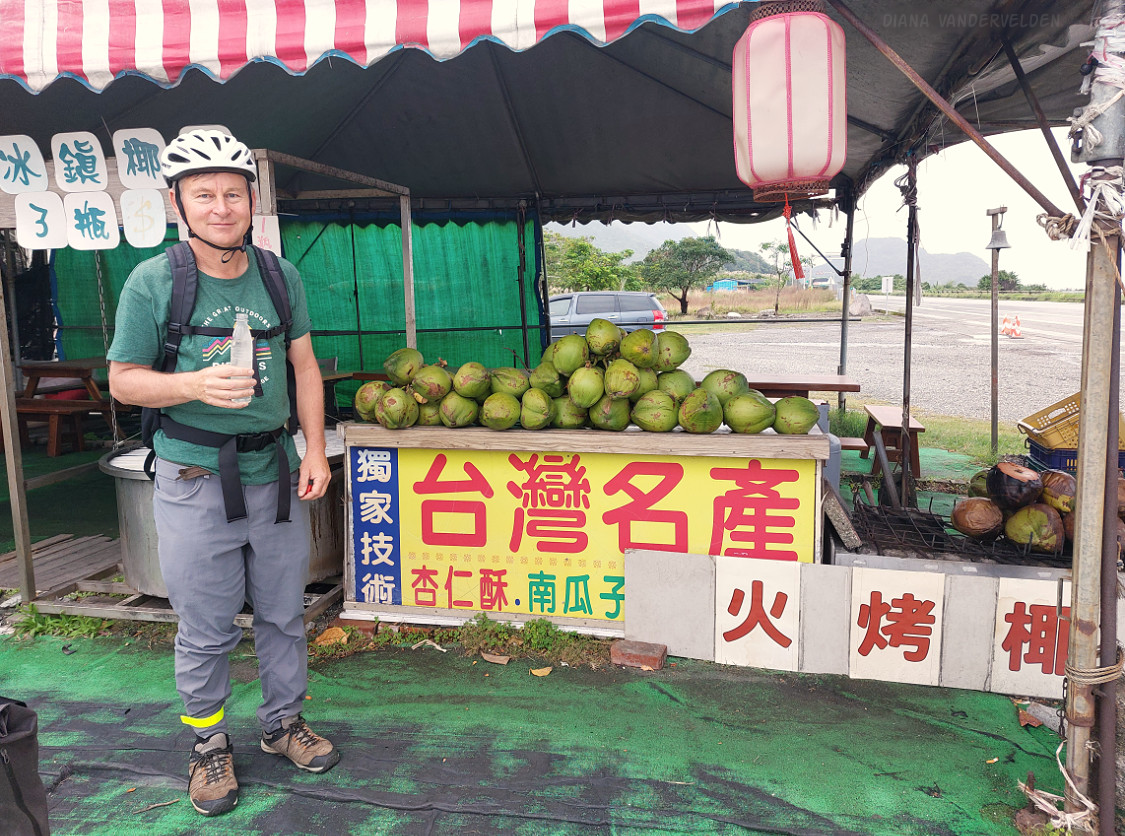
There were some aboriginal vendors at the Tropic of Cancer marker. We bought some fresh coconut water.
The local specialty in this area is smoked flying fish.
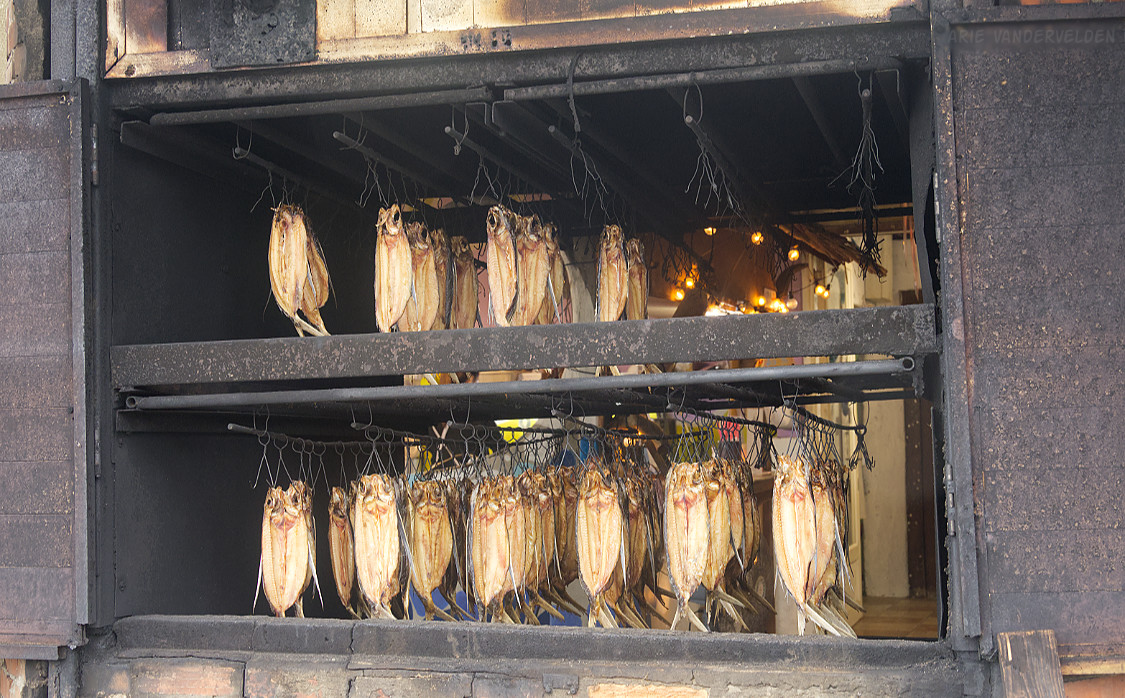
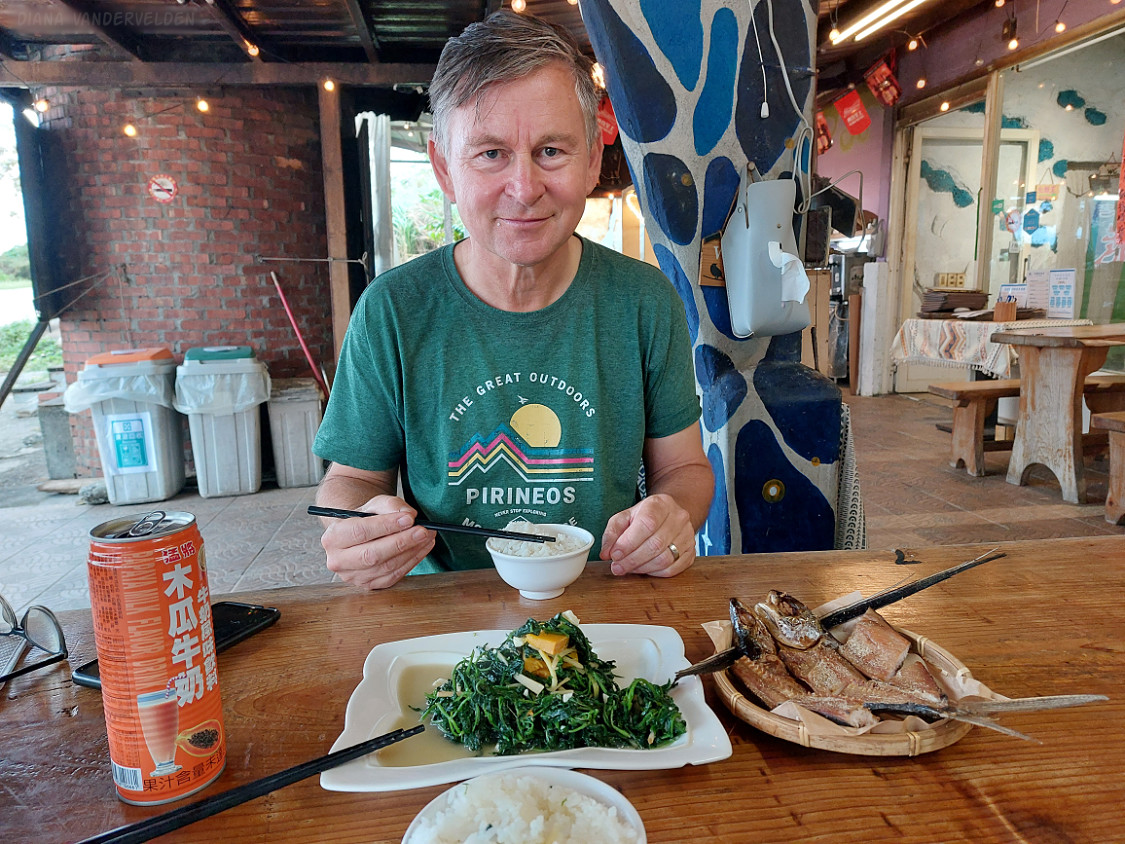
We tried some for lunch. It was quite tasty.
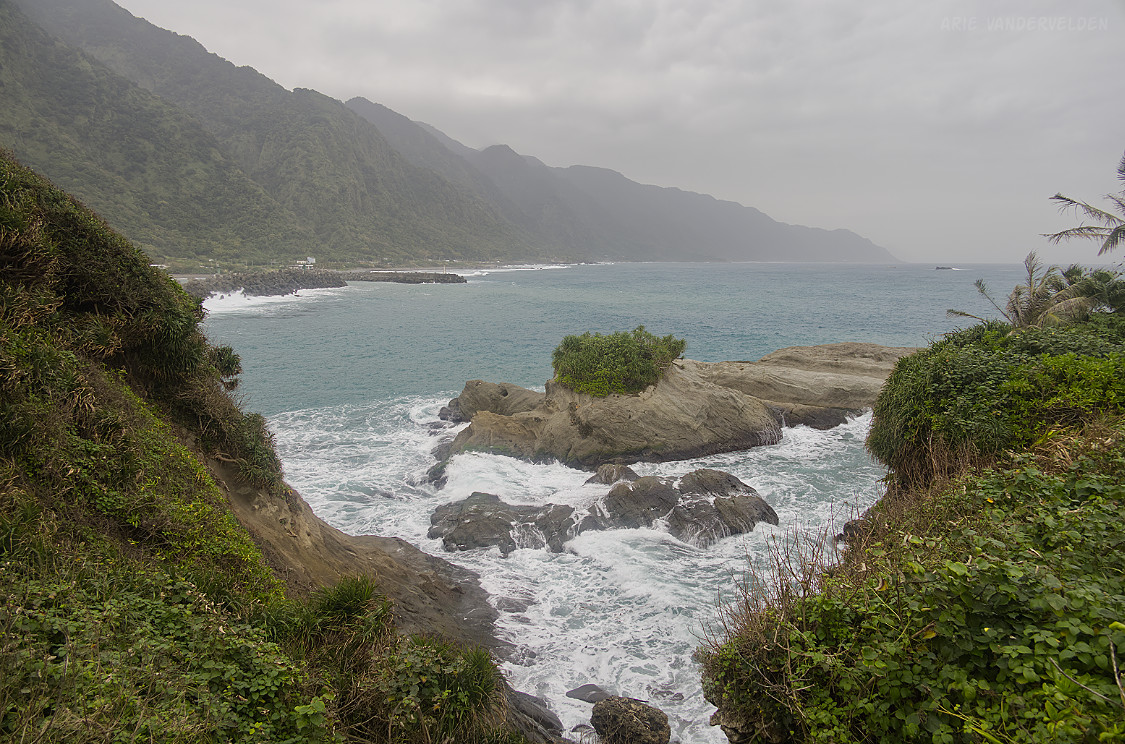
Our next stop was Shitiping National Scenic Area. Huge waves were pounding against the rocks.
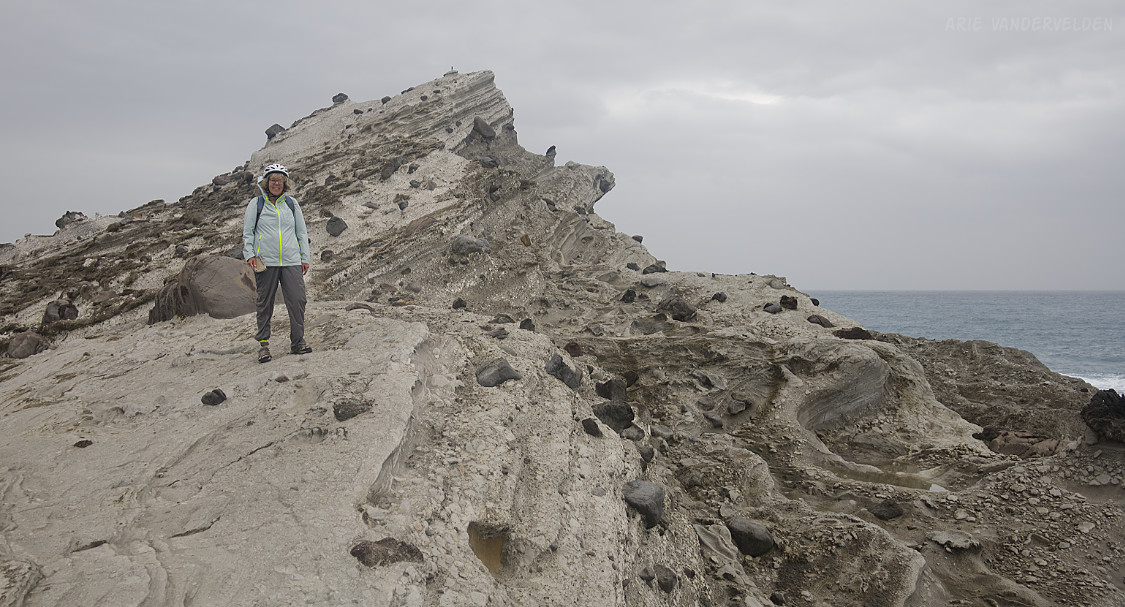
We looked around an outcrop that seemed to be composed of explosive volcanic rocks. Huge black basalt boulders were embedded in grey ash layers. I’ve never seen anything quite like it.
We detoured inland a bit to cross a river on a bridge. This provided views of the countryside.
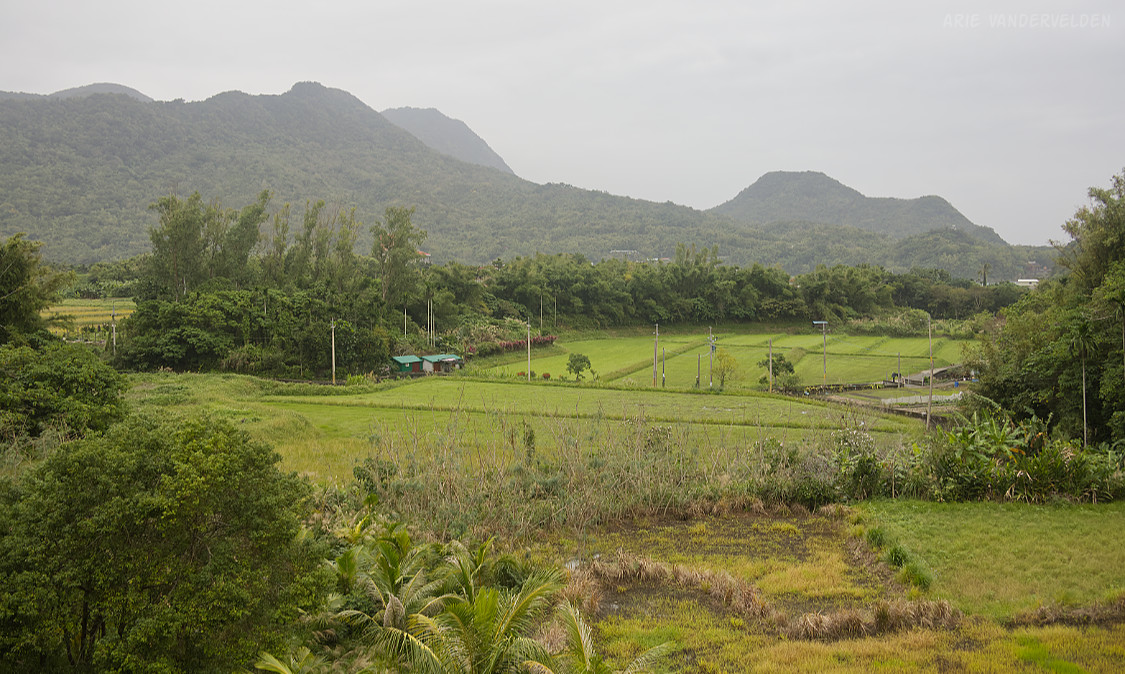
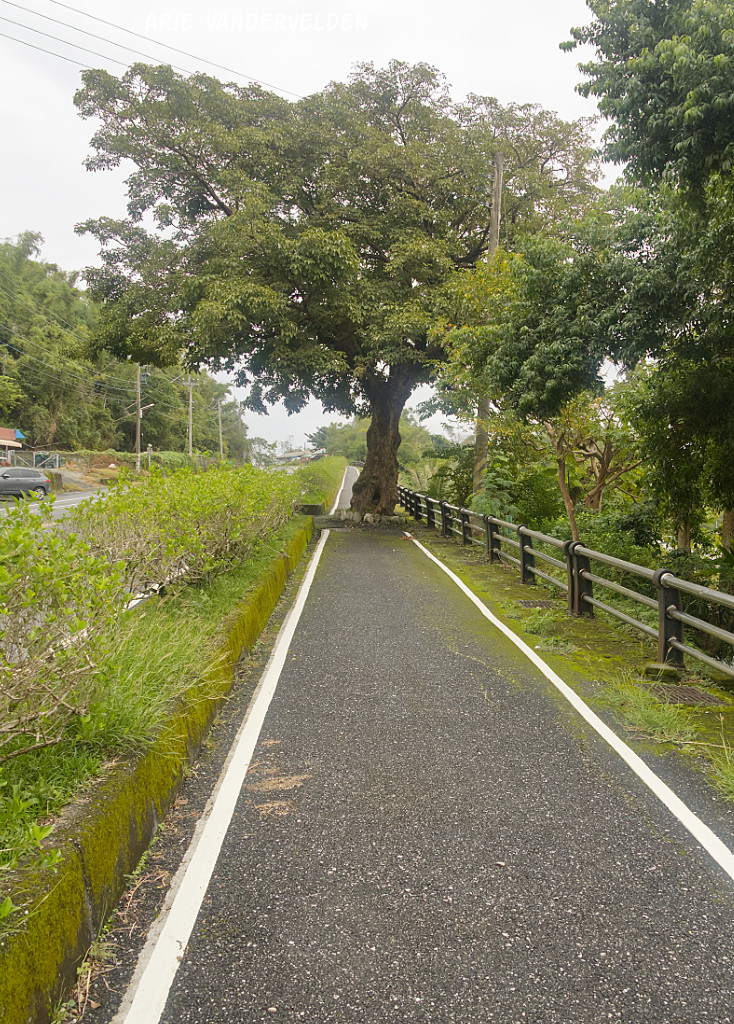
Sometimes, obstacles get in your way, and you just have to find a way around. I suppose the tree was here first….
Day 4
On day four the weather started improving. The sun was filtering through the clouds, and the winds had lessened. The waves seemed calmer too.
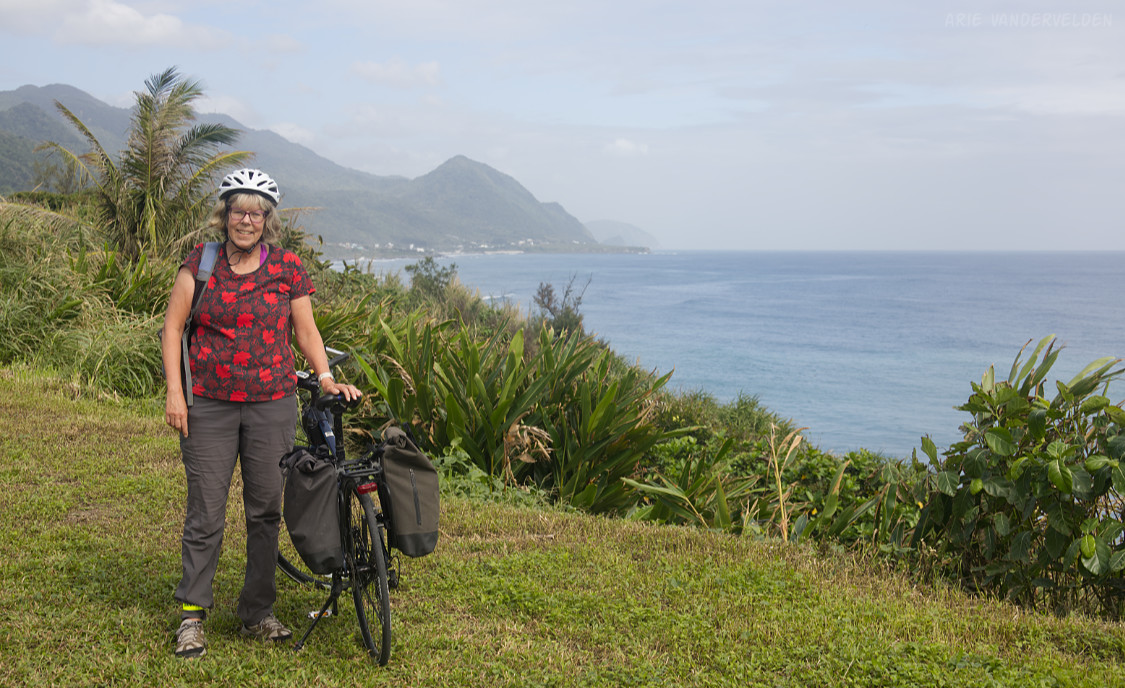
There were some big views along this stretch of coastline.
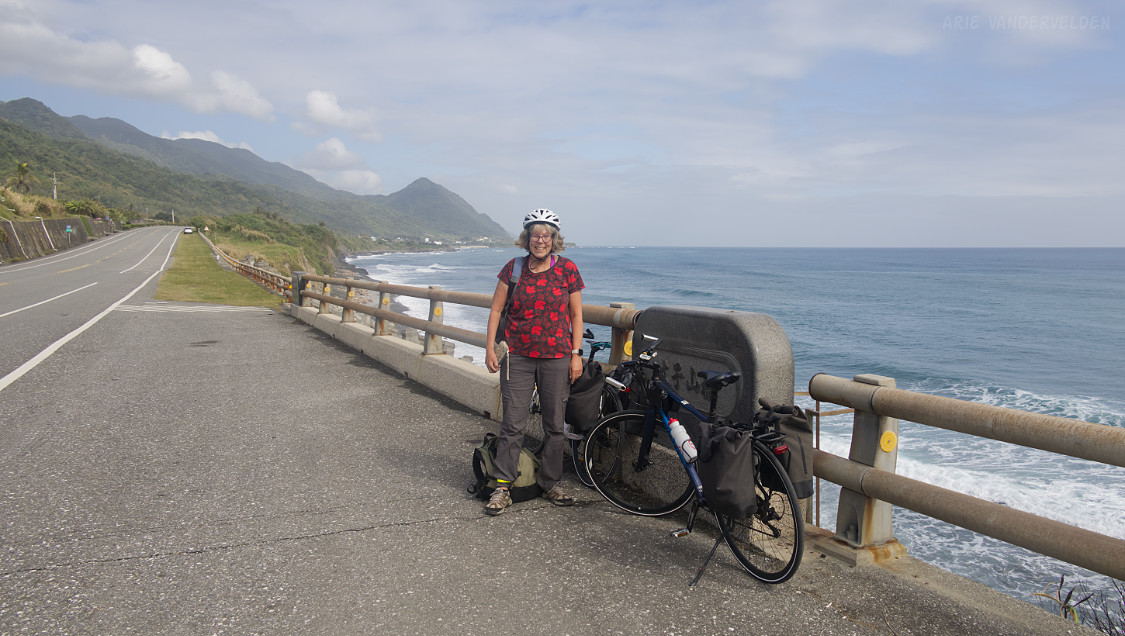
These geese had a pen with a view.
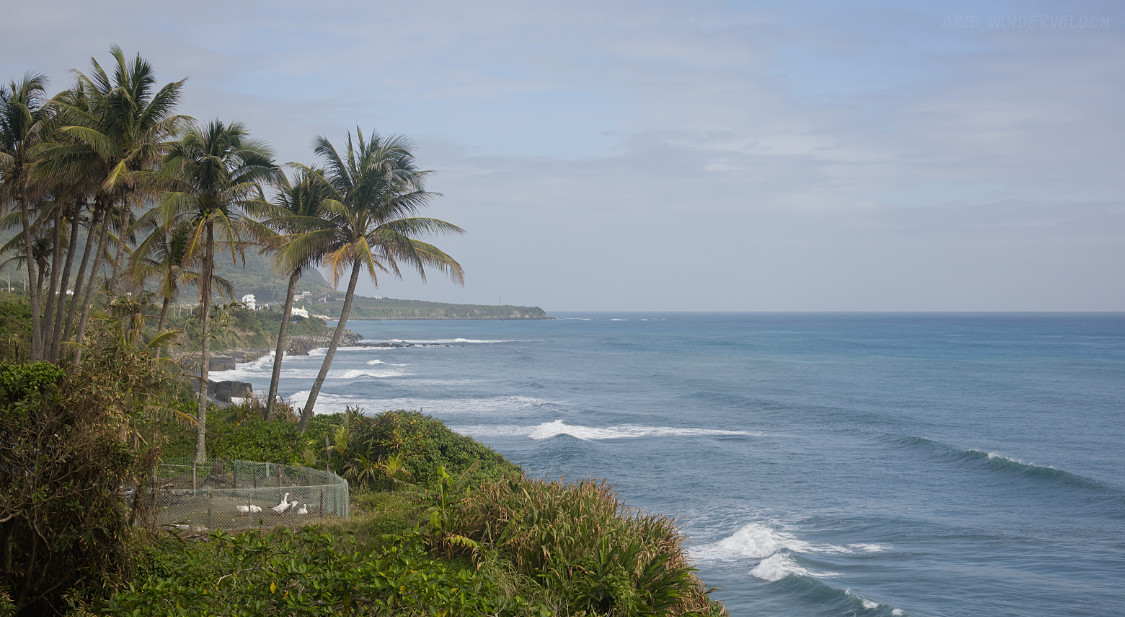
This section of Taiwan’s coast has a very narrow coastal plain.
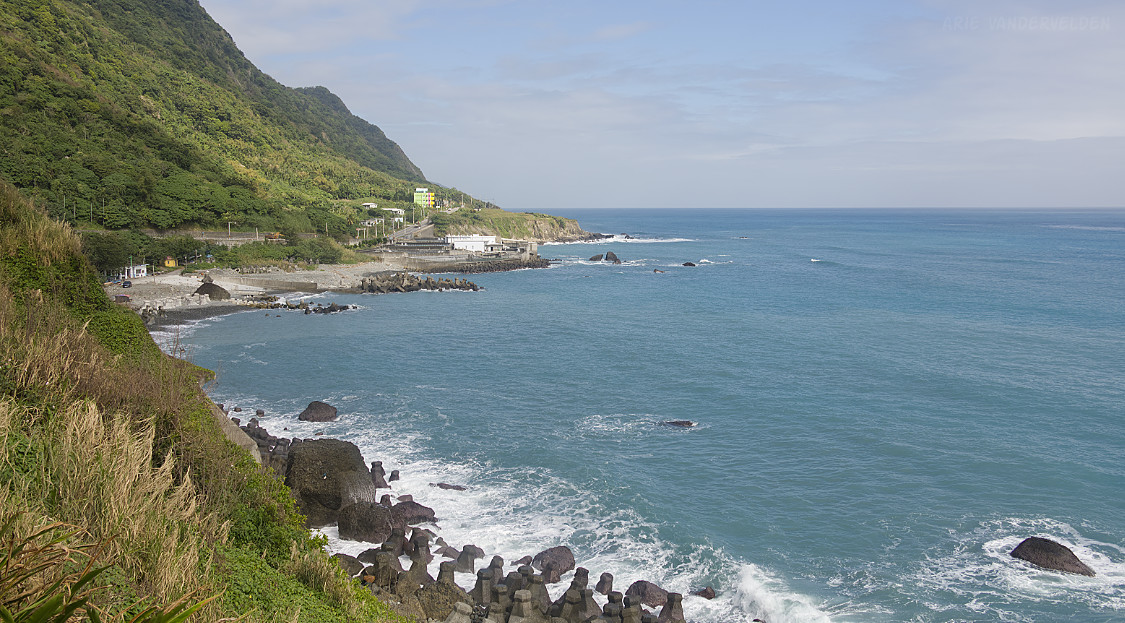
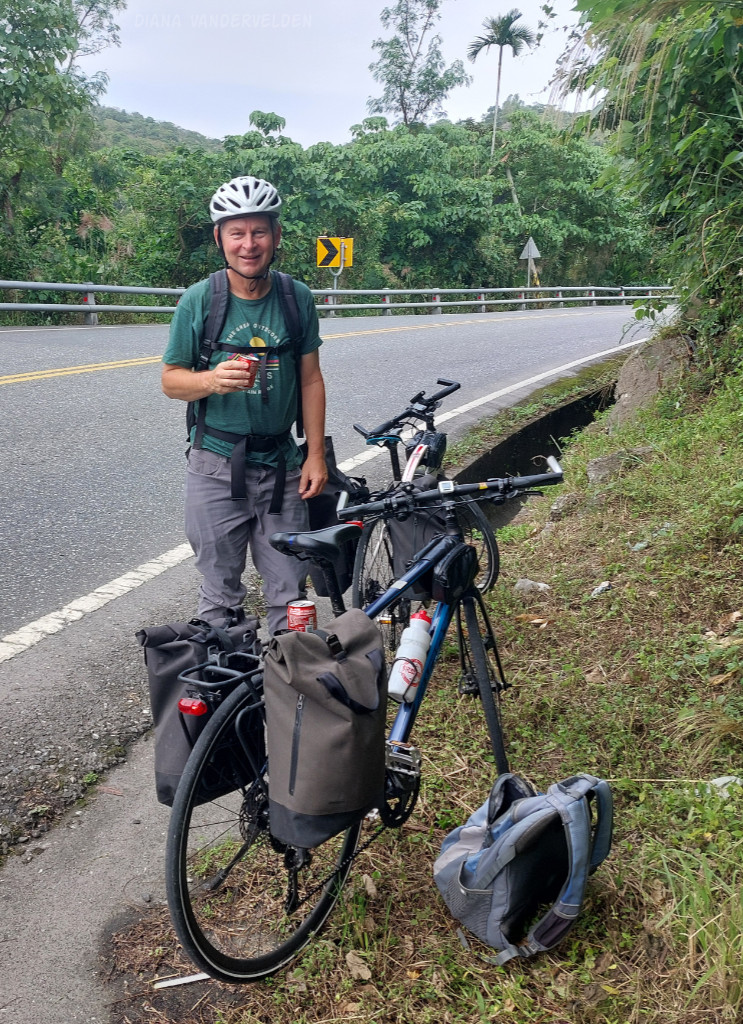
Eventually the coastal plain runs out entirely, and steep cliffs plunge straight into the ocean. Here, route 11 heads inland and starts climbing to a pass. The road was steep and narrow, and there were not many spots to pull out. When we did find one, we pulled over to have a drink.
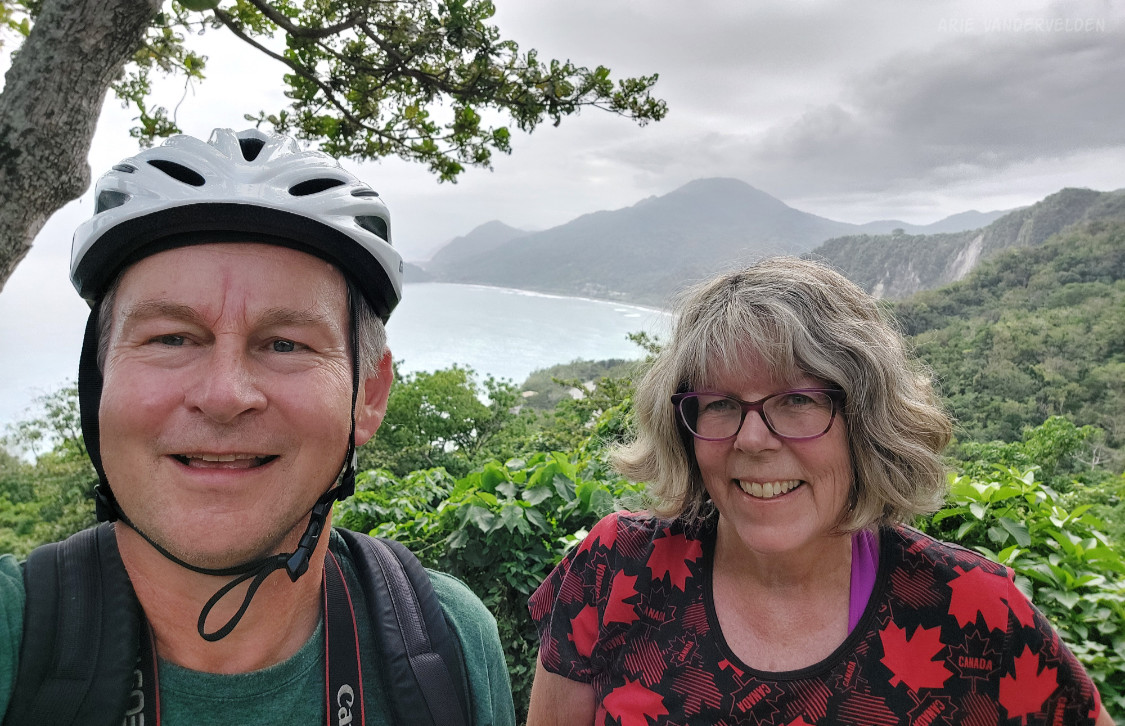
Two-thirds of the way up is Baqi viewpoint. Drinks and snacks are for sale here at a tidy little shop. Baqi is a pleasant spot, and we lingered for a while.
The road climbed to a summit, descended close to sea level, and then climbed up to a second, lower pass. From the second summit, the descent was through a tunnel. What’s more, the tunnel did not have a bike lane our shoulders. There were no alternatives, no detours, no local roads around this tunnel. I looked at Diana and said: go, and go fast. Shooting the tunnels was a claustrophobic and scary. We emerged at the bottom shaking with adrenaline. And right at the bottom was our B&B. We were way too early to check in, so we plunked down in the garden and relaxed, glad to be alive.
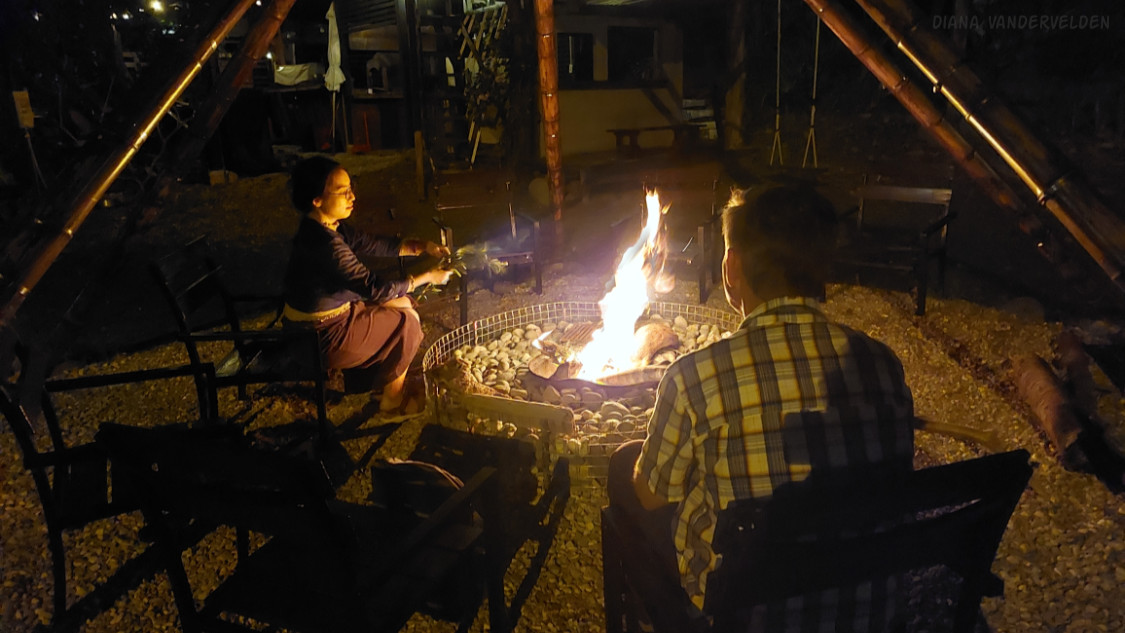
Our stay at Bridge 12 B&B was a wonderful experience. In the evening we sat around the fire in the yard and had a conversation with our host Jolene. She told us she had rescued a few pangolins that had showed up in her garden. Good for her – pangolins are a highly endangered species.
Day 5
Our last day was a short and easy one. After a short distance, our destination of Hualien came into view. Huge mountains tower over Hualien.
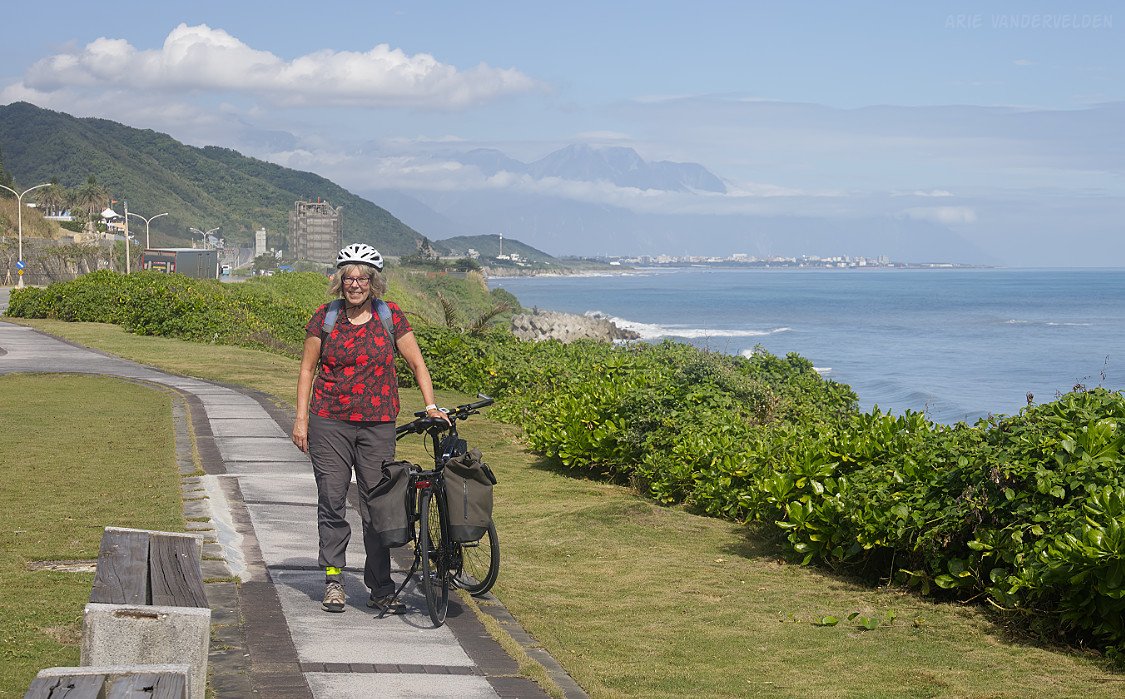
Hualien is a big city, and I had worried about cycling through it. But it ended up being easy and scenic. There was a biking/walking path along the shore.
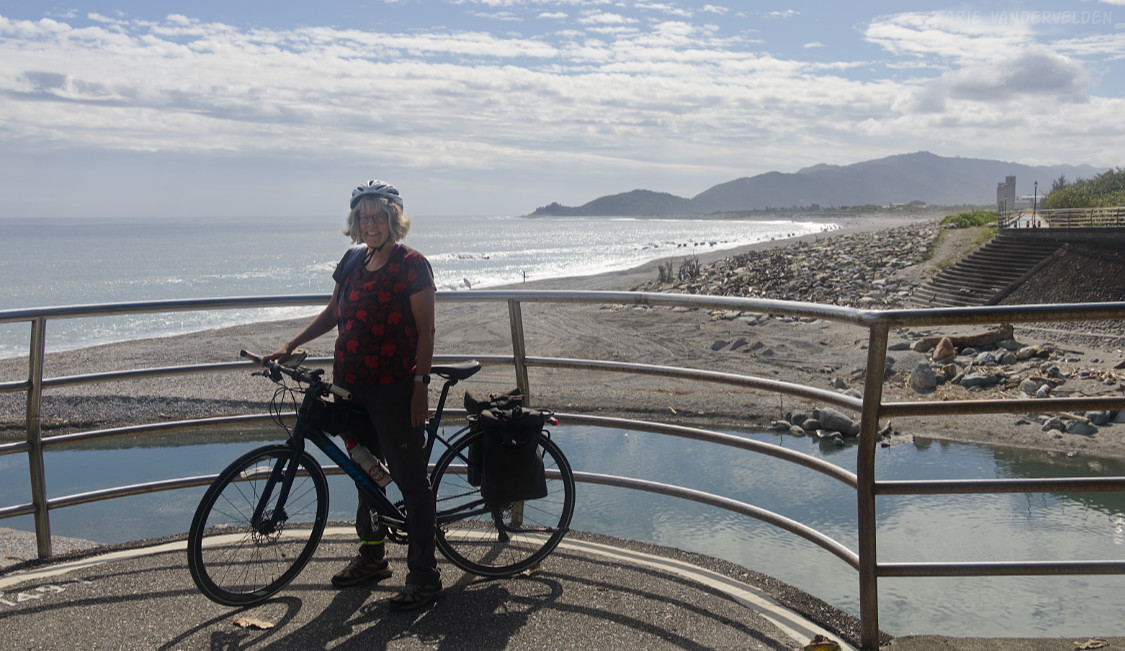
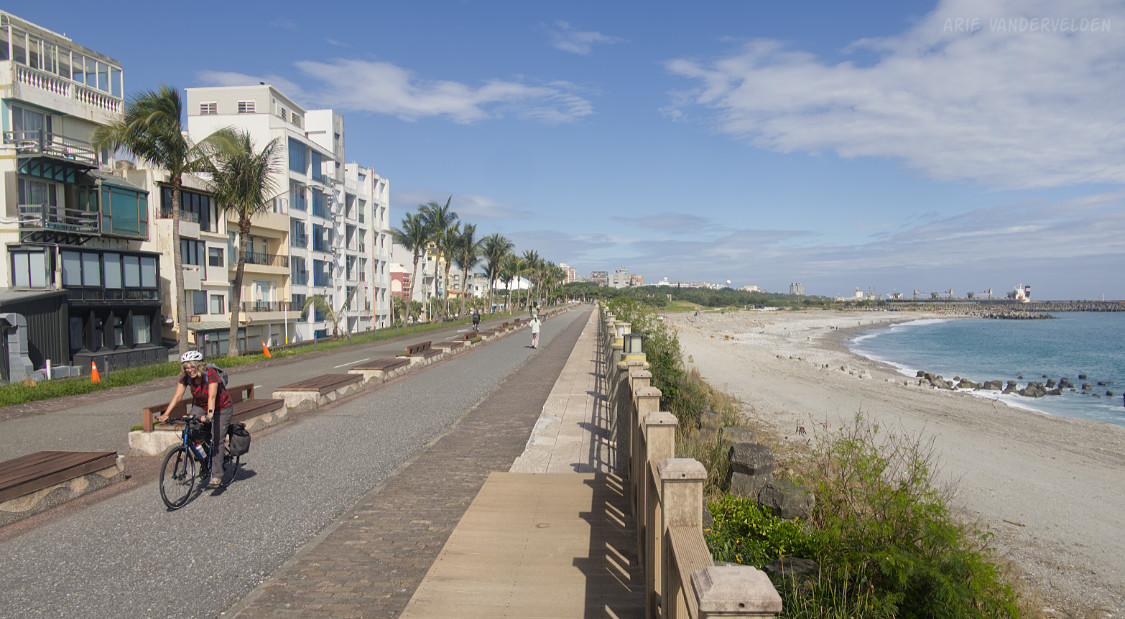
With so many seaside parks and pathways, Hualien has a laid-back feel about it. Once we reached the seafront opposite downtown, we celebrated with some victory drinks.
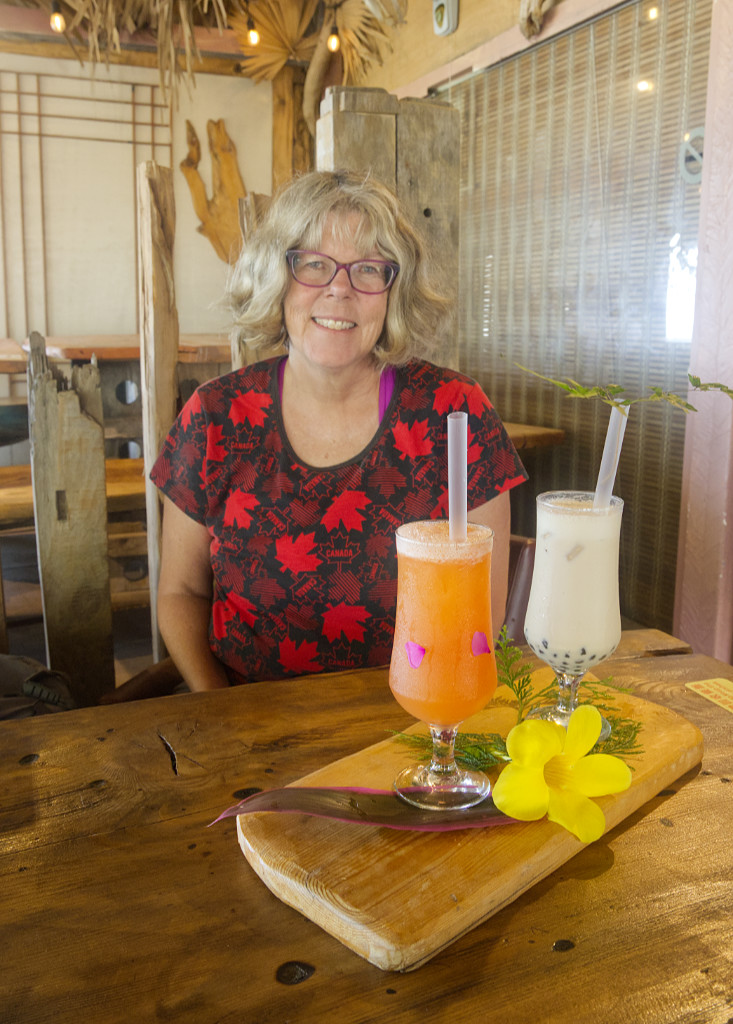
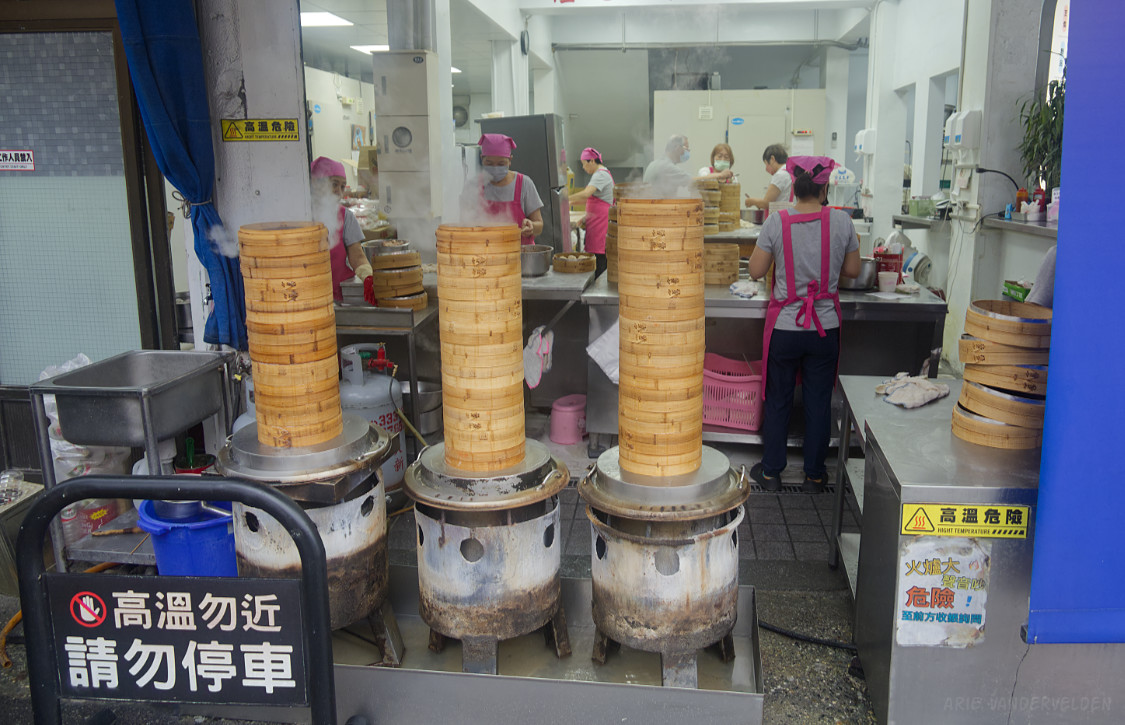
Downtown and a train station are a kilometer or two inland, and I had worried about having to cycle though busy downtown streets. But a pathway along the river led us right to the station and to the Giant store where we dropped off our bikes.
We had a look around Hualien before leaving. It felt much more “Chinese” after having cycled through aboriginal villages and towns. We spotted a shop where soup dumplings (xiaolongbao) were being steamed in large numbers.
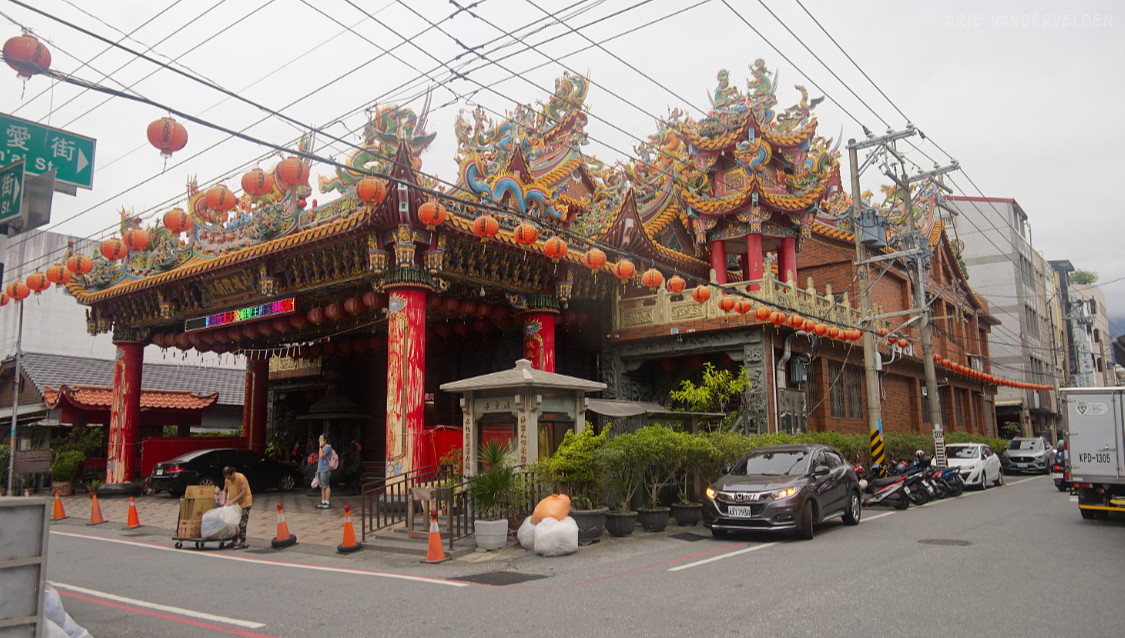
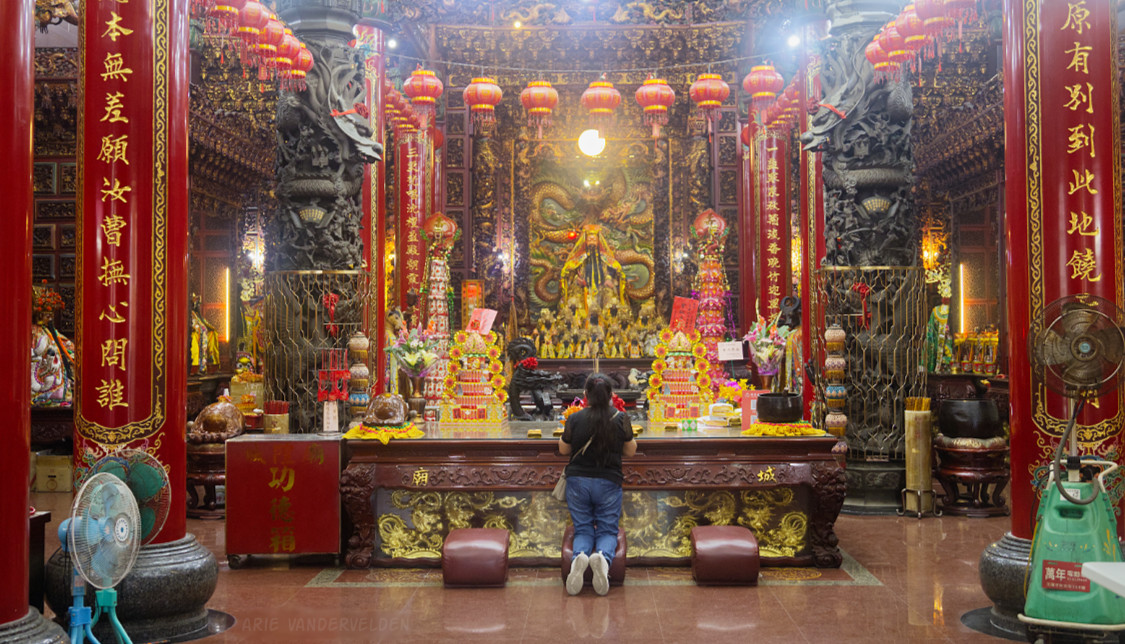
We stopped by Chenghuang Temple.
Our hotel had a view of Hualien train station and the mountains. At regular intervals, fighter jets came screaming by on approach to the nearby air strip. Again we were reminded of Taiwan’s political predicament.
Logistics
From Taipei, there are several direct trains each day to Taitung and Hualien. Taitung’s train station is a few kilometers outside of the city center, and there are shuttle busses that take you downtown.
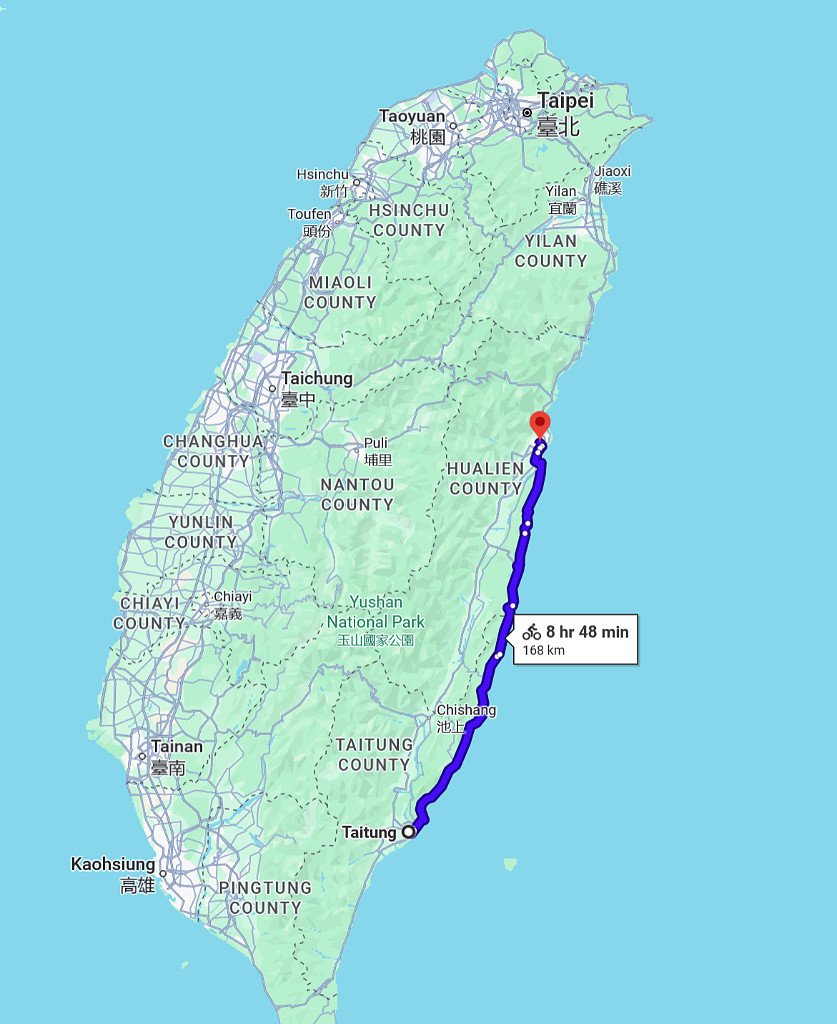
Giant, the bicycle manufacturer, has shops throughout Taiwan. They do rentals as well, and it is possible to pick up a bike at one store and drop it off at another. We picked up at Taitung and dropped off at Hualien. Note that Taitung has two Giant stores – the one that does rentals is on Gengsheng Road. It is possible to book bikes online. The type of bike you want is “Endurance Round Island Tours”. The bikes we received were really nice and light “Fastroad SLR2” hybrid bikes. The bikes come with racks, panniers, locks, a pump, and basic lights. They do not come with helmets, and helmets cannot be rented separately. We bought helmets at the Giant store (CAD 40) and liked them so much we brought them home. We also ended up buying a spare inner tube and tire levers. I also recommend buying or bringing a few more lights to make yourself visible to motorists.
In addition to bike rentals, Giant also does luggage forwarding. We left our big backpacks at the Giant store in Taitung, and our bags were waiting for us at the Giant store in Hualien. This was very, very convenient.
Taiwan’s roads are smooth and well-maintained. Potholes are virtually non-existent. From Taitung to Changbin there are bike/motorbike lanes beside the driving lanes. From Changbin to Fengbin there is a bike lane that is physically separated from other traffic, which is awesome. However, north of Fengbin the situation varies between bike/motorbike adjacent to the driving lanes, to having no lanes our shoulder at all and having to cycle with traffic.
At the north end of the route are several tunnels. The Baqi tunnel has a narrow shoulder and it is very short. North of there are a 2.4 km long series of tunnels with no shoulder. Heading north, these tunnels have a downhill slope and can be negotiated fairly quickly. Even so, these tunnels are claustrophobic and scary. I would not want to attempt these tunnels in the reverse/uphill direction (southbound).
Internet wisdom says that this route is best cycled from south to north in summer, and from north to south in winter, so as to take advantage of the prevailing winds. However, the tunnel consideration (see above) is much more significant than the wind, in my opinion. Maybe hardcore road cyclists would scoff at this and be fine climbing uphill in a tunnel together with traffic. However, as a recreational cyclist I simply would not want to do this. After negotiating the tunnels we felt so grateful and lucky to have chosen to go from south to north. Another plus point is that when going from south to north you are cycling on the side of the ocean. In short, I highly recommend going south to north, no matter what the season.
We cycled the route over the course of five days. We stayed at:
- The Suites Taitung. Nice hotel in the center of town. Recommended.
- Jacaranda House, Donghe. The owners are very friendly and hospitable, and the accommodations are luxurious. Highly recommended.
- Grain Educator Home. Nice B&B. The owner kindly drove us to a restaurant when it was dark and pouring rain. Recommended.
- Aqua Tree Resort. Luxurious but pricey hotel. Recommended.
- Bridge 12 B&B. We came as strangers and left as friends. Our stay here was a highlight of our trip. Highly recommended.
- Hi-Yes Hotel, Hualien. Nice hotel in the center of town. Recommended.
Most hotels and shops accept credit cards, but some do not. It is advisable to bring some cash. If you run out of cash, you can get more at ATMs in convenience stores. Drinks and snacks (and meals, in a pinch) are available at convenience stores. You’ll pass convenience stores quite frequently in the southern half of the route. But in the north they are further apart, so you’ll need to stock up when you can.
We cycled the route during the last week of November 2026.